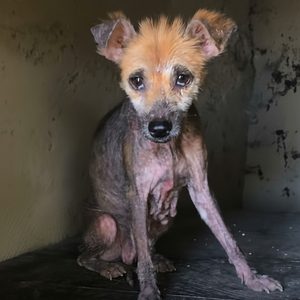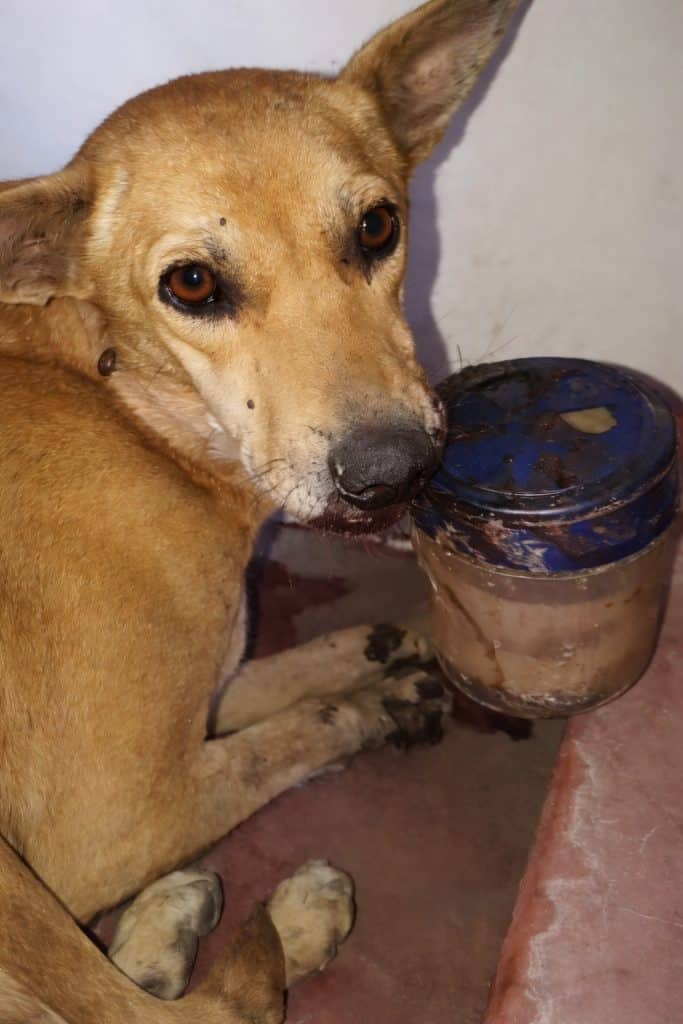
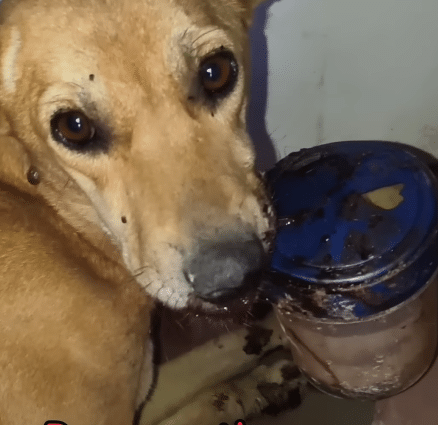
The video opens with a heartbreaking image: a thin, yellow stray dog curled tightly against a concrete wall. His body is small and tense, as if trying to disappear into the shadows. But what makes the scene especially painful is not just his frailty—it is the hard plastic food container tightly lodged over his snout.
The rigid jar, with its bright green lid, is wedged deep around his muzzle and jaw. It fits so tightly that he cannot open his mouth. Eating is impossible. Drinking is nearly impossible. Even breathing appears strained. His eyes are wide—not aggressive, not angry—but filled with confusion and exhaustion. It is likely he had tried to lick leftover food inside the container and became trapped for days.
A Silent Struggle for Survival
For a stray dog, survival already demands constant effort. Food must be searched for. Shelter must be found. Danger must be avoided. Now, with his mouth sealed by plastic, those basic instincts are blocked.
He cannot bark for help.
He cannot chew.
He cannot properly pant to cool himself.
Each passing hour drains his strength further.
Video: A Stray Dog “Locked” in Plastic and the Rescue That Gave Him Back His Voice
The Rescue Team Arrives
Thankfully, help comes before it is too late. Members of Animal Warriors Conservation Society arrive on scene. They understand immediately that this is a delicate and dangerous situation. A frightened dog in distress can react unpredictably, and sharp tools will soon be needed.
Using a humane catch net, they carefully secure him to prevent sudden movement. The goal is not restraint—it is protection. Protection for the rescuers, and more importantly, protection for the dog whose fear is understandable.
Once the dog is safely stabilized, the rescuers assess the container. It cannot simply be pulled off. It has sealed too tightly around his face, and forcing it could cause injury.
One rescuer gently holds the dog’s head steady through the net while another uses heavy-duty cutting pliers to carefully slice through the thick plastic. The process is slow and deliberate. Small sections are cut away piece by piece. Every movement is cautious, ensuring the sharp blades never come close to his eyes, nose, or skin.
The dog squirms slightly—not from aggression, but from fear and fatigue. The team remains calm, speaking softly. Patience becomes the most important tool in that moment.
The Moment of Freedom
Finally, after careful cutting, the plastic splits. The jar loosens. It falls away.
For the first time in days, the dog’s mouth is free.
He is released from the net and immediately moves away from the stressful scene, still cautious but visibly relieved. His body language shifts—no longer rigid with panic, but unsure, processing what just happened.
The First Drink
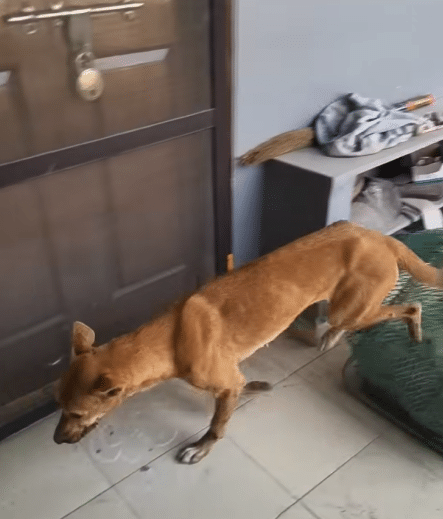
One of the most powerful moments follows quietly. The dog lowers his head to drink water from a wide, safe container. He drinks steadily, almost urgently. It may be his first proper drink since becoming trapped.
That simple act—lapping water freely—marks the return of something fundamental: dignity, comfort, survival.
No dramatic celebration.
No loud triumph.
Just a thirsty dog finally able to drink.
A Small Reminder with a Big Meaning
This story is not only about rescue. It is also about responsibility.
Discarded plastic containers may seem harmless, but to animals drawn by leftover scents, they can become dangerous traps. A simple habit—rinsing containers, crushing them, or cutting them open before disposal—can prevent suffering like this.
The stray dog survived because someone noticed and chose to act. But prevention begins long before rescue is needed.
Sometimes, compassion means stopping to help.
Sometimes, it means thinking ahead.
And for one small dog, both made all the difference.