In a forgotten corner of Mustafa Kamel, Egypt, life continued as usual.
Cars passed. Markets buzzed. People hurried home before sunset.
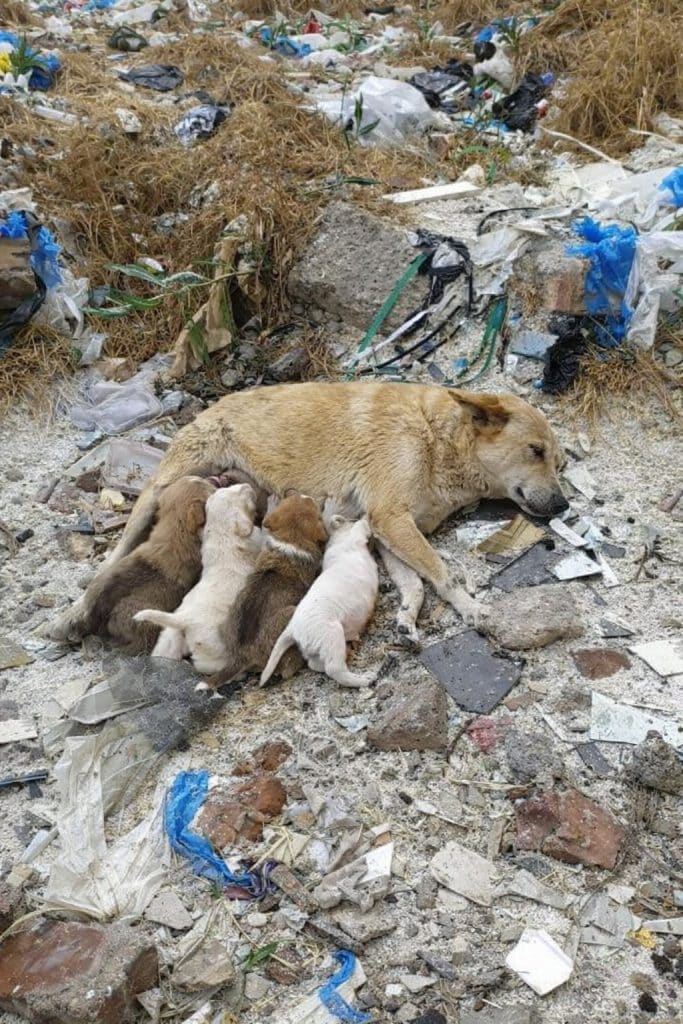
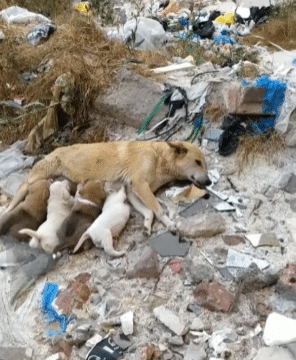
And in the middle of a landfill scattered with bricks, torn fabric, and discarded furniture, a small family tried quietly to survive.
She was thin—her golden coat dull and uneven, her body frail against the rough ground beneath her.
Curled close to her were four tiny puppies.
She had once given birth to ten.
Only four remained.
The rest had not survived the harshness of their surroundings.
Yet she stayed.
Not because she was strong.
But because she was a mother.
A Body That Could No Longer Carry Its Own Weight
It became clear that her suffering ran deeper than hunger.
Her back legs were severely injured. She could not stand properly. Each attempt to move required immense effort, her body dragging forward in slow, painful motions. Her spine appeared damaged, forcing her to lie on her side for long stretches of time.
Several of her teeth were broken.
Life had not been gentle with her.
Still, when her puppies nudged against her, she shifted her body carefully—making space for them to nurse. Her eyes looked heavy and exhausted, but she did not turn away from them.
Pain was present.
So was devotion.
Video: Disabled Mother Dog Crawls Through Trash to Feed Her Puppies — A Love Stronger Than Pain
A Man Who Chose Not to Look Away
Her story might have ended there—hidden in debris and dust—if not for one man.
Ahmed Abdel Hamid noticed her.
At first, when he reached out, she reacted with fear. Her body tensed. She bared her teeth—not out of aggression, but out of instinct. A wounded mother protects what little she has left.
But Ahmed did not rush.
He moved slowly. Spoke softly.
And after a moment that felt longer than it was, she allowed him to touch her.
It was the beginning of trust.
Each day, Ahmed returned with clean water, milk, bread, and scraps of meat. He fed the puppies first. Then he made sure she ate too.
They sheltered themselves wherever they could—inside broken walls, beneath old carpets, under discarded sofas left to decay in the open air.
It was not safe.
But it was all they had.
Growing Puppies, Fragile Hope
With consistent food and care, the four puppies began to change.
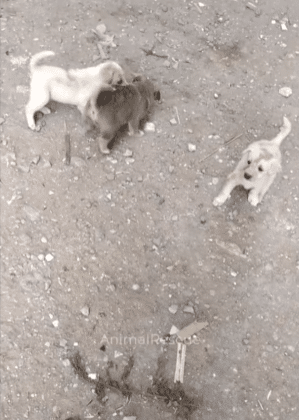
Their coats grew fuller. Their steps became steadier. Soon, they were chasing each other across the uneven ground, tumbling playfully over bits of stone and dirt.
They wagged their tails when Ahmed arrived.
They ate eagerly, bumping into one another in harmless competition.
For the first time, their world felt a little less uncertain.
But their mother’s struggle remained visible.
There were moments captured on video where she attempted to move—dragging her injured legs behind her, shifting her body inch by inch. The effort was clear. So was the discomfort.
Yet she kept trying.
As if movement itself was proof that she had not given up.
Resting, But Not Fully Safe
In the final moments of the footage, she lies quietly on the warm brick surface after nursing her puppies.
Her breathing is slower.
Her body finally still.
She has eaten more regularly now, thanks to Ahmed. But her injuries remain untreated. The landfill is still dangerous—sharp objects, unsanitary conditions, extreme weather.
Her eyes, though softer than before, still carry fatigue.
Relief has arrived in small portions.
Healing has not yet begun.
What This Mother’s Story Teaches Us
Her story is not only about hardship.
It is about endurance.
About the quiet strength that appears when everything else has been taken away.
Even with a broken body, she did not abandon her role.
Even when six puppies were lost, she protected the four who remained.
And because one man paused long enough to care, those four puppies now have a fighting chance.
But they need more.
A landfill cannot replace a clinic.
Daily bread cannot repair injured legs.
Temporary shelter cannot substitute for safety.
Her journey reminds us that compassion is not a grand gesture.
It begins with one person choosing to see.
And sometimes, that choice is the difference between despair and hope.
Today, she is still there—waiting.
Not for sympathy.
But for the chance to heal, and for her puppies to grow up somewhere far from broken things.