It was the kind of cold that settles deep into your bones.
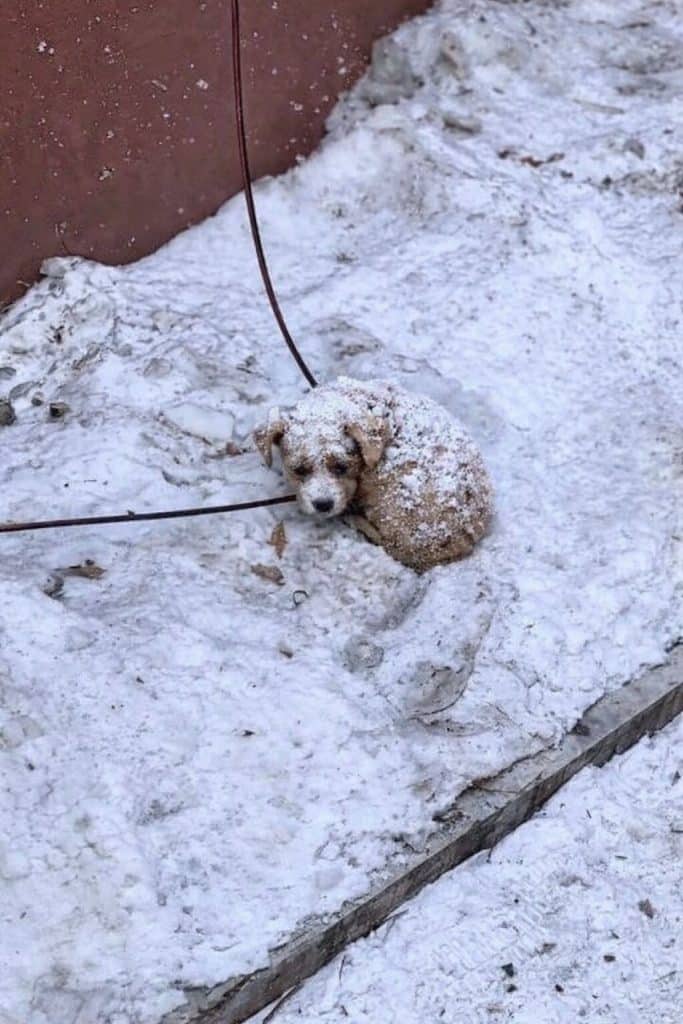
The air stood still at -10°C, and the world outside looked almost silent beneath a blanket of white. In the middle of that frozen stillness, a tiny shape curled into itself, barely visible against the snow.
She was no bigger than a small bundle of fur.
Her body trembled uncontrollably. Each breath formed a faint cloud in the icy air. She had tucked her nose beneath her tail as if trying to disappear from the world — or perhaps simply trying to survive another minute.
Her eyes told a quiet story.
Not anger. Not aggression.
Just fear… and exhaustion.
A Cry That Was Really a Plea
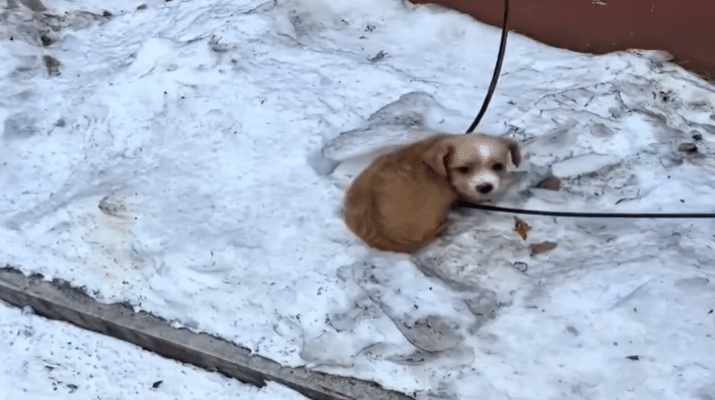
When someone finally approached her, she did not greet them with relief.
She cried out.
A sharp, panicked sound that echoed across the snow. She tried to defend herself in the only way she knew how — by warning the world to stay away.
It wasn’t hostility.
It was memory.
A small life like hers does not learn fear without reason.
But the rescuer did not step back. Instead, they spoke softly. No sudden movements. No pressure. Just patience.
After a few long moments, they gently placed her into a simple cardboard box — not as confinement, but as protection — and carried her away from the freezing ground.
Away from the snow.
Away from the cold.
Toward warmth.
Video: From Frozen and Afraid to Joyfully Running Through Her New Home
The First Night Indoors
Inside the house, the air felt different.
Warm. Quiet. Safe.
But she did not understand that yet.
She remained curled into herself, small and guarded. Even the soft blanket beneath her seemed unfamiliar. Every sound made her flinch. Every movement around her caused her to tense.
Food was offered — warm porridge mixed with sausage — but she refused.
Trust does not grow in a single evening.
Later, dry kibble softened with milk was placed nearby. She hesitated.
Then slowly… she took a few bites.
It was a small moment.
But it mattered.
A Visit to the Veterinarian
To ensure she was safe, she was taken for a full examination.
Tests were performed to rule out serious infections. Thankfully, results came back negative. No parvovirus. No contagious illness.
But something was still wrong.
She struggled when she tried to walk.
An X-ray revealed that her bones were not broken. Instead, her joints showed weakness — the result of severe malnutrition. The veterinarian also explained that prolonged exposure to extreme cold may have affected her joints as well.
Her small body had simply not been given what it needed to grow strong.
But there was hope.
With proper nutrition, warmth, and consistent care, she could recover.
And that is exactly what she received.
This was the turning point.
Days passed.
Then weeks.
Her body began to fill out. Her coat grew softer. Her movements became steadier. The trembling that once defined her slowly disappeared.
But the most remarkable change was in her eyes.
They no longer scanned the room for danger.
They searched for connection.
One afternoon, as her rescuer prepared to leave for work, something unexpected happened.
She ran to the door.
Her tail wagged.
Not cautiously. Not uncertainly.
But with pure excitement.
When the door opened again later that day, she raced forward to greet the person who had once lifted her from the snow.
The same tiny dog who once screamed in fear now welcomed the world with joy.
The Quiet Power of Warmth
There was no dramatic rescue equipment.
No loud declarations.
Just one simple act — someone choosing not to walk away.
The warmth of a room. The consistency of meals. The patience of gentle voices.
Those small things became the bridge between fear and trust.
Today, she runs freely through her home.
She plays.
She wags her tail.
She waits by the door.
And when she curls up now, it is not from fear.
It is from comfort.
Sometimes, healing does not arrive in grand gestures.
Sometimes, it arrives as a cardboard box carried through the snow.
And sometimes, that is enough to change an entire life.