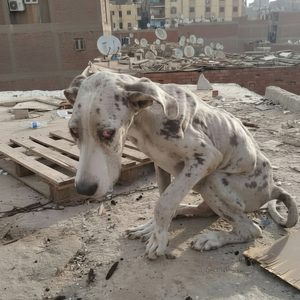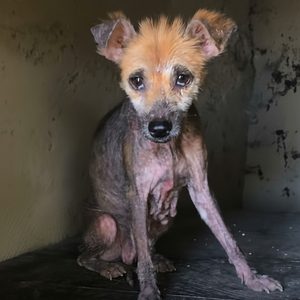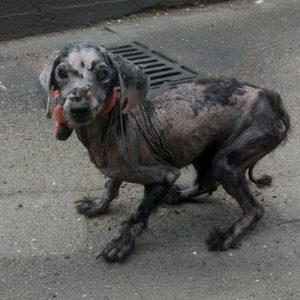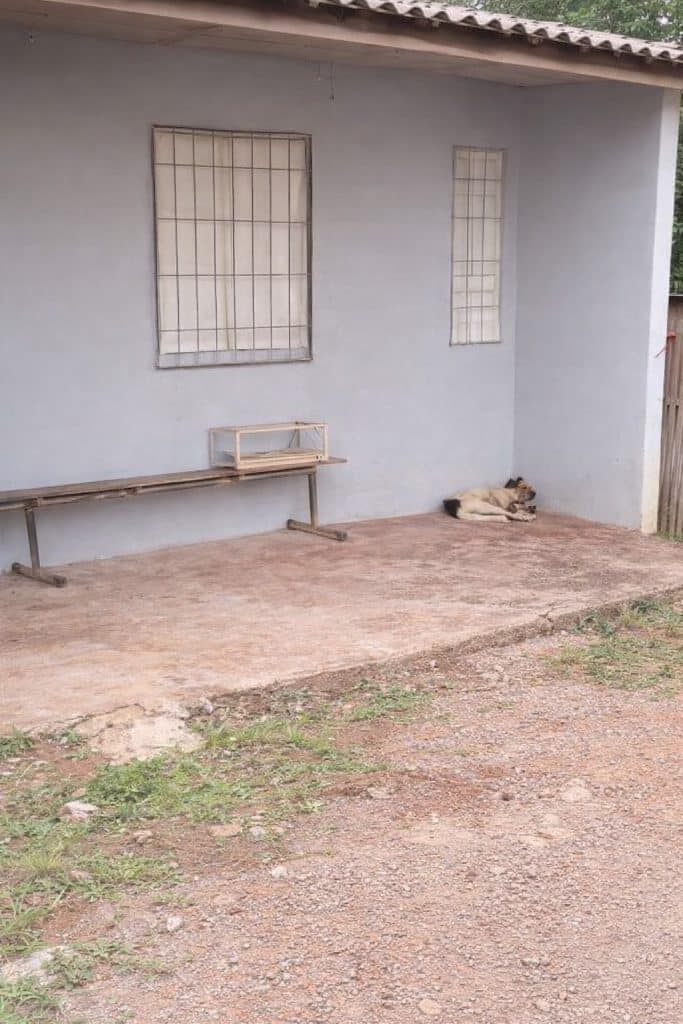
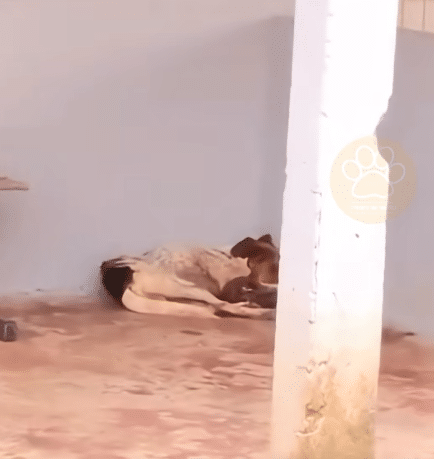
In a quiet corner of Custódia Freire, in Acre, Brazil, a small dog lay pressed against a cold wall.
He was so thin, so still, that he nearly disappeared into the darkness around him.
His body was curled tightly, as if trying to protect what little strength he had left. He could not rise. He could not call out. Only his eyes moved — slowly, faintly — carrying a silent plea that someone might notice him before it was too late.
He did not look like a dog waiting to be rescued.
He looked like a life that had already been forgotten.
When the Truth Became Clear
When rescuers approached, the gravity of his condition became painfully evident. His fragile body was overwhelmed by severe infection. Deep wounds caused by parasites had been left untreated for far too long. Each breath seemed heavy. Every movement appeared to cost him effort he no longer had.
He could not stand.
He could barely lift his head.
At the veterinary clinic, the assessment was careful and honest. His condition was critical. Treatment would be risky because his body was so weak — but without intervention, survival was unlikely.
There was only one option.
Try.
And hope.
Video: From the Darkest Corner to a Second Chance — Pudim’s Fight to Live
A Quiet Fight No One Could See
Against expectations, the small dog began responding to treatment.
Even while still frail, he tried — gently — to raise his head. It was not a dramatic moment. It was not a sudden miracle. It was simply a sign that he had not given up.
That quiet effort meant everything.
He was given a name: Pudim.
And with that name came a promise — that he would no longer face the world alone.
Despite everything his body had endured, his will to live remained untouched. There was no bitterness in his eyes. No aggression. Only a fragile determination that surprised everyone around him.
The Cost of Survival
The days of neglect had left permanent marks.
One of Pudim’s front legs had been too severely damaged to recover. The injury could not be reversed. It was a difficult reality to accept — but it did not define his future.
Healing, for Pudim, would look different.
And slowly, it began.
At first, the changes were almost invisible. A small tail movement. A hesitant bite of food taken without assistance. A steadying breath that no longer sounded strained.
Each tiny improvement felt like progress measured not in miles, but in moments.
Learning to Trust Again
As Pudim grew stronger, something deeper began to shift.
He started leaning gently toward the hands that cared for him. When someone entered the room, his eyes followed — not with fear, but with curiosity. The dog who once lay motionless in the shadows now made small, determined attempts to move closer to comfort.
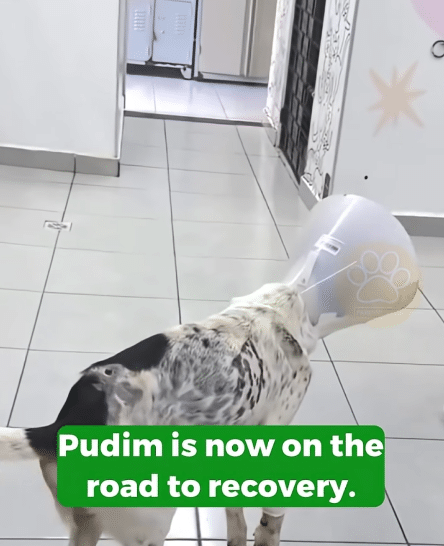
His first attempts to walk were uneven. Careful. Unsteady.
But he tried.
Each step, though imperfect, carried intention. Each movement toward his caregiver’s outstretched hand felt like a quiet declaration: I am still here.
The veterinarians and rescuers remained patient. There was no rush. No expectation for dramatic transformation. Only steady care, warmth, and reassurance.
And Pudim responded in his own time.
More Than Survival
Today, Pudim continues to recover.
His body is healing. His strength is returning. And though he will always carry the physical reminder of what he endured, he no longer carries the weight of abandonment.
His story is not about tragedy.
It is about what becomes possible when compassion intervenes before it is too late.
Pudim reminds us that:
Healing does not need to be perfect to be meaningful.
Strength can exist even in the smallest body.
And sometimes, survival begins with someone simply choosing to stop and look.
In a corner where he once faded into darkness, a small dog found his way back into the light.
Not because the world changed overnight.
But because someone decided he mattered.