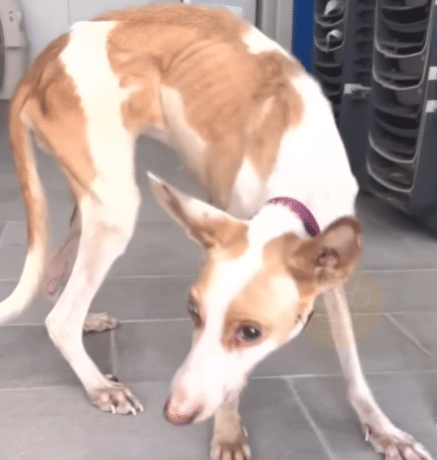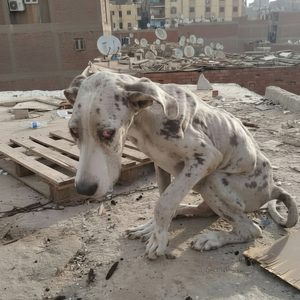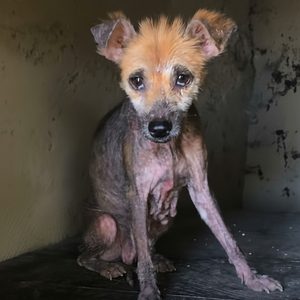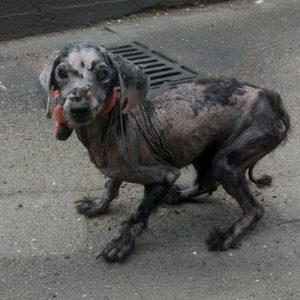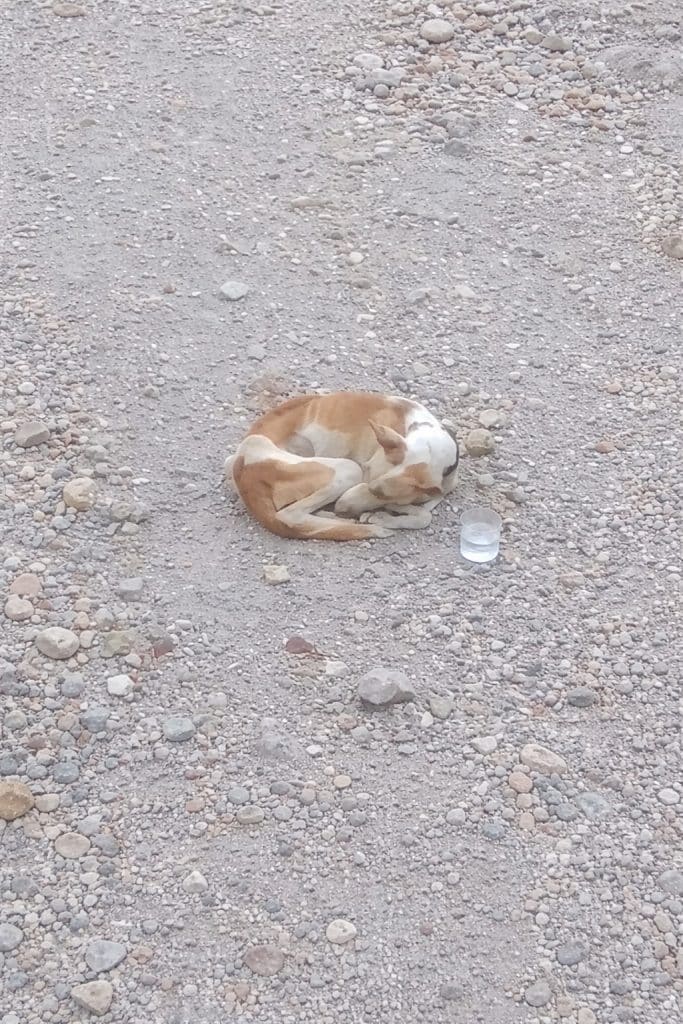
In a dry, rocky riverbed, someone noticed a shape that didn’t belong there.
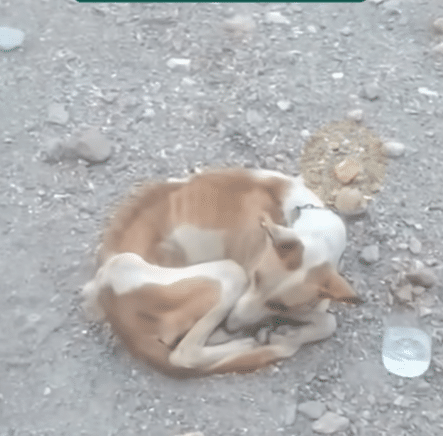
Curled tightly against the gravel lay a skeletal dog. His ribs were visible beneath thin skin. A wound marked the top of his head. He could not stand. He barely lifted his face.
He was blind.
And he seemed to be slipping away.
The land around him was harsh and empty. No shelter. No water. No sign that anyone had been caring for him.
Those who found him knew one thing immediately:
Leaving him there was not an option.
A Rescue Built on Patience
The first volunteer to arrive was Raquel.
She approached slowly, speaking softly. But pain and fear had built walls around him. When she tried to touch him, he reacted defensively — not out of aggression, but out of terror.
He had learned that touch could hurt.
Understanding that this rescue required extra care, Raquel waited for another team member, Maria, to assist. Together, they moved carefully, wrapping him gently and lifting him to safety.
He trembled.
But he did not fight once he realized he was being carried.
The footage captures a fragile dog curled against stone, occasionally lifting his head in the smallest gesture of connection.
Video: Blind and Abandoned in a Dry Riverbed — He Still Tried to Look Up
A Name That Meant Hope
At the veterinary clinic, his condition appeared heartbreaking.
He seemed to have lost his will to survive. He lay still, withdrawn, as if expecting nothing more from the world.
The volunteers named him Peep.
Because even while curled inward, even while weak and blind, he would sometimes lift his head slightly — just enough to “peep” upward toward the voices speaking gently to him.
It was subtle.
But it was connection.
Medical exams began immediately.
Infections were treated first. His body needed stabilization. Then an MRI revealed the deeper truth:
One side of his brain had been damaged by external trauma.
There were no tumors.
No degenerative disease.
The blindness and motor difficulties were the result of injury.
Injury caused by force.
His condition was not an accident of nature.
It was the consequence of cruelty.
The Slow Return of Strength
Despite everything, that small upward glance became the team’s anchor.
They saw in him not defeat, but endurance.
Day by day, Peep began responding to care.
He accepted food from a caregiver’s hand. Even though his body was still unsteady and his legs were wrapped in bandages, he tried to stand.
He wobbled.
He faltered.
But he did not collapse back into resignation.
His appetite returned gradually.
His body grew slightly stronger.
His trust deepened.
He leaned into touch.
He rested calmly beside those who stayed near him.
He was no longer alone with his pain.
A Face That Speaks Without Sight
Peep may not see the world.
But those who sit beside him say he feels it.
He responds to voices. He recognizes the rhythm of familiar footsteps. He presses his head gently into open palms.
The video closes with a close-up of his gentle face — clouded eyes, soft expression — as he is stroked carefully.
He does not shrink away.
He leans closer.
What Peep’s Story Reminds Us
Some wounds are visible.
Others are carried quietly.
Peep’s blindness does not define him. His injury does not erase his capacity for connection.
Even in a dry riverbed, abandoned and fading, he tried to look up.
That tiny gesture changed everything.
Because sometimes hope is not loud.
Sometimes it is just a small movement of the head — a silent request that someone stay.
And when someone does, healing begins.