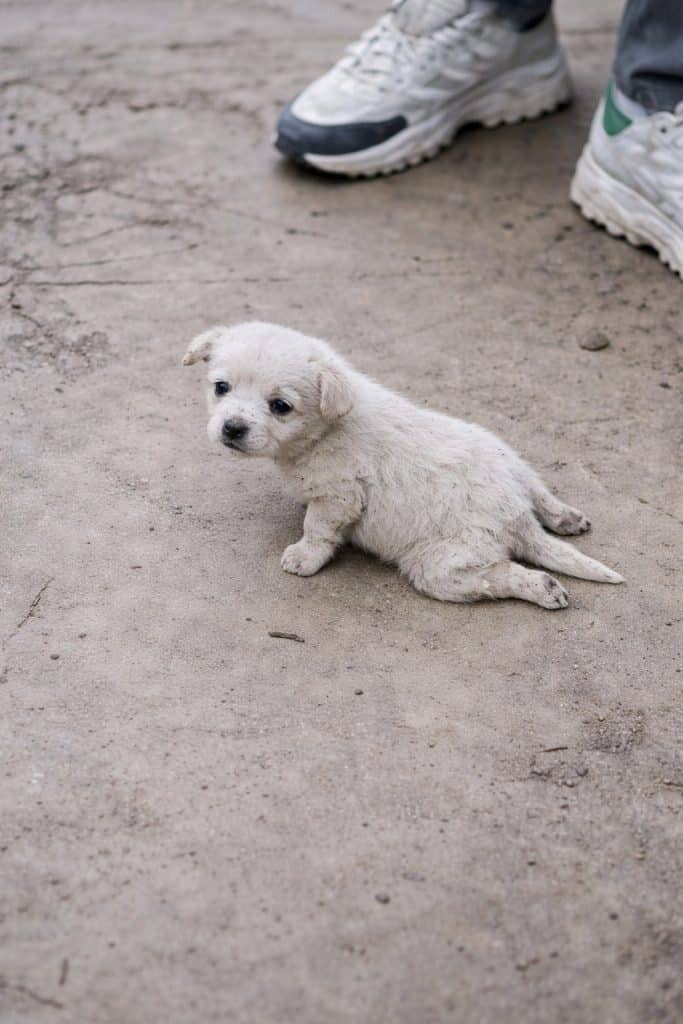
He was found outside a supermarket.
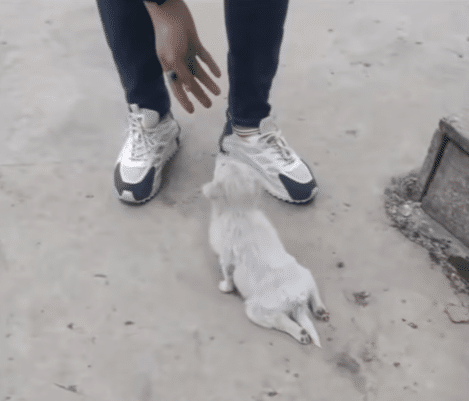
While people came and went with shopping bags in hand, a small dog lay near the entrance, exhausted. His two back legs were completely paralyzed. To move, he used only his front legs, dragging the rest of his body across the ground.
Each small movement scraped against the pavement.
He was thin, worn down, and visibly struggling.
And yet, when he looked up at passersby, there was something unexpected in his eyes.
Hope.
Even after being ignored again and again, he still seemed to believe someone might stop.
Finally, someone did.
The turning point begins the moment someone chooses to lift him instead of walking past.
Emergency Care at Home
Because it was the weekend, he could not be taken to the hospital immediately.
The rescuer contacted a veterinarian for guidance and began caring for him at home. He was gently bathed, given nourishing food, and treated for fever under professional advice.
His skin wounds — caused by dragging himself over rough surfaces — were carefully cleaned.
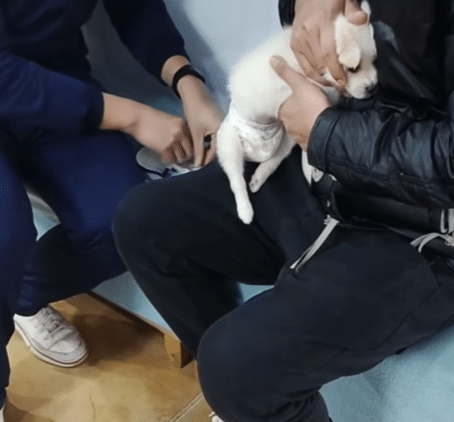
To maintain hygiene and protect his body, he was fitted with a diaper and kept in a clean, safe space indoors.
For the first time, he was no longer on cold pavement.
He was surrounded by attention.
Video: The Puppy Who Dragged Himself Across the Ground — And Found a Family
The Diagnosis
The next morning, he was taken for X-rays.
The results confirmed what his body had already revealed — a fractured spine, likely from a recent accident.
The injury had left his hind legs completely paralyzed.
Dragging himself had also caused damage to his knees, compounding his discomfort.
Surgery was initially considered. But after thorough evaluation, doctors determined that the fracture site was too risky for an operation. Surgical intervention could cause more harm than benefit.
The safest path forward would be conservative treatment through medication and careful monitoring.
A Routine of Determination
From that day on, every morning at 10 a.m., he was brought to the hospital for treatment according to a new medical plan.
Day after day.
No dramatic shortcuts.
No instant miracles.
Just consistency.
Medication.
Observation.
Support.
A Remarkable Shift in Spirit
After just one week, changes became visible.
His appetite improved.
His weight increased slightly.
The wounds on his skin began to heal.
But the most powerful transformation was not physical.
It was emotional.
The fatigue and sadness that once clouded his face began to lift. He started moving energetically — running around the house using only his front legs, navigating with surprising agility.
He even formed a playful friendship with a black cat in the home.
They chased each other gently.
They shared space.
They learned each other’s rhythm.
Laughter replaced worry inside the house.
The rescuers spent time talking to him, petting him, encouraging him — not because he needed constant medical intervention, but because he needed connection.
A Different Definition of Recovery
Today, he is no longer a dog dragging himself across supermarket pavement.
He is a family member.
Will he ever walk normally on all four legs again?
The chances are uncertain, perhaps low.
But what matters most is this:
He is not in pain.
He is not alone.
He is not forgotten.
He plays.
He eats well.
He rests safely.
And while his caregivers continue hoping for further improvement, they already see something miraculous.
He is happy.
Sometimes healing does not mean returning to what was lost.
Sometimes it means building a life so full of love that the injury no longer defines the story.
And in this home, that is exactly what he has found.