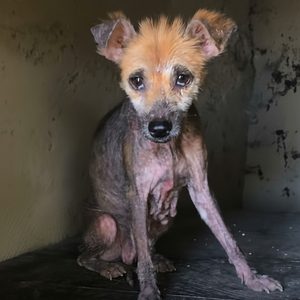
The first time Eva was seen, she appeared heartbreakingly delicate. Her body was thin, her movements slow and careful, as if every shift of weight demanded courage. Yet even in that fragile condition, there was something impossible to miss. Her eyes held awareness. Not fear alone, not defeat—but a quiet determination that suggested she had not given up on life, even after enduring more hardship than most could imagine.
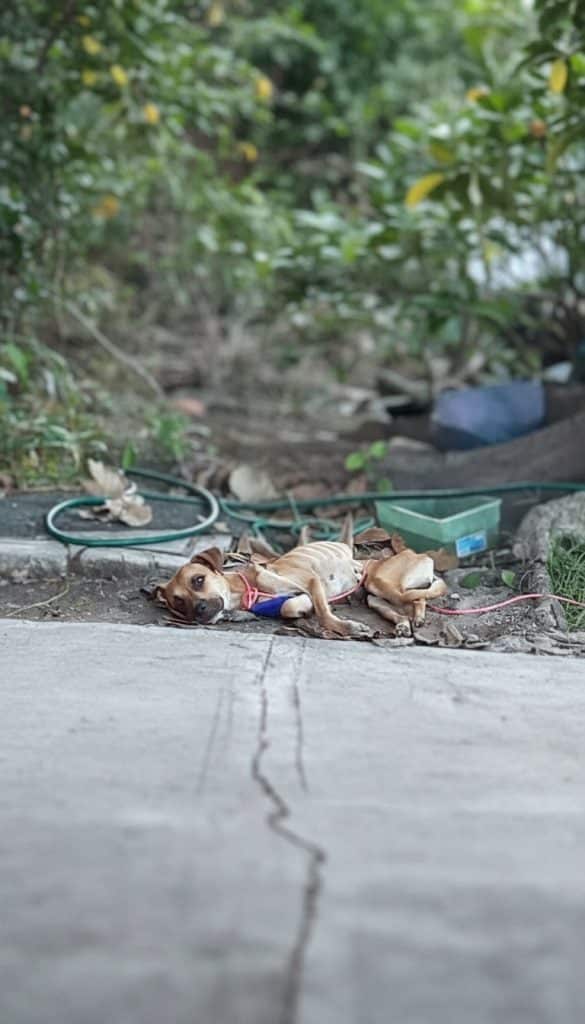
She lay still as someone approached, offering gentle words instead of sudden movements. Eva didn’t try to pull away. Instead, she raised her head slightly, as if acknowledging that help had finally arrived. That small gesture spoke volumes. It was trust, tentative but sincere, and it changed everything in that moment.
Wrapped carefully in a soft blanket, Eva was lifted into a car and placed gently on the seat beside her rescuer. There was a silent promise made then—one that required no words. From that point forward, she would not be left to suffer alone again.
A Spirit That Refused to Fade
Despite her obvious physical struggles, Eva revealed early signs of resilience. Her back legs did not respond as they should, yet her appetite remained strong. She ate eagerly, each bite a quiet declaration that she still wanted to live. For an animal dealing with long-term pain, that willingness to eat was more than a good sign—it was proof of a fighting spirit.
What stood out just as much was her temperament. Eva was calm and gentle, even while clearly uncomfortable. When someone reached out to stroke her head, she leaned into the touch, closing her eyes as if memorizing the feeling. She seemed to recognize kindness instantly, responding not with fear, but with acceptance.
An appointment with a specialist was arranged without delay. Answers were needed. More importantly, Eva deserved relief. During the drive, she lay quietly, her breathing steady. There were moments when her body trembled, but she never cried out. She simply endured, as she had for far too long.
Video Resilient Eva’s Second Chance: How Love Carried Her From Pain to a Forever Home
Understanding the Source of Her Pain
The examination brought clarity, though it was not easy to hear. Imaging revealed serious damage to Eva’s spine. Two vertebrae had been injured long ago, leaving her partially paralyzed and in constant discomfort. The injury was not recent—it had been with her for a long time, forcing her to adapt to pain as part of daily life.
The diagnosis was heavy, but it also brought direction. Knowing what Eva was facing allowed her caregivers to shift their focus from uncertainty to action. While full recovery of movement was unlikely, the specialist explained that Eva could still enjoy a fulfilling, happy life with proper care and pain management.
What mattered most was comfort. Quality of life became the priority.
A New Focus on Healing
Eva began a carefully managed treatment plan designed to reduce pain and inflammation. Every day, she received her medication patiently, never resisting, never showing frustration. Her calm nature remained unchanged, even in vulnerability.
Gradually, small improvements began to appear. She seemed more relaxed. Her posture softened. She lifted her head with greater ease, and her breathing became deeper and more peaceful. These changes may have seemed minor to an outside observer, but to those who cared for her, they were milestones.

Her appetite grew stronger, and so did her engagement with the world around her. Eva became more alert, following movements with her eyes, responding to voices, and seeking gentle interaction. Pain had once kept her distant. As it eased, her personality emerged.
The Return of Joy
Weeks passed, and Eva continued to surprise everyone. Each day brought subtle progress. A brighter look in her eyes. A soft wag of her tail. A deeper enjoyment of simple routines like brushing or quiet time beside someone she trusted.
Most remarkable was the change in her expression. The exhaustion that once clouded her gaze slowly gave way to curiosity. Eva began greeting familiar faces with anticipation, ears perking at sounds she recognized. She wasn’t just existing anymore—she was participating.
It became clear that her journey was not only physical. As her body found relief, her confidence returned. She learned that she was safe. That she mattered. That she deserved care without conditions.

The Quiet Strength of Trust
Throughout everything, Eva’s gentleness never faded. She allowed herself to be handled, supported, and helped without fear. That level of trust, especially after a life marked by hardship, was extraordinary.
Her progress was not without challenges. Some days were harder than others. There were moments when improvement slowed, when patience was tested. But Eva never stopped trying. She met each day with the same quiet courage, reminding everyone around her that healing is not always measured in steps taken, but in spirit regained.
A Family Who Saw Her True Worth
As Eva’s story spread, it reached the hearts of a family far away—one who saw her not as a case or a condition, but as a soul. They looked beyond her limitations and recognized the gentle, resilient dog she truly was.
Their decision to adopt her felt meant to be. Their home was ready, both in structure and in heart, to support her needs. When the time came for Eva to leave, it was an emotional farewell—but one filled with gratitude and hope.
Her arrival marked the beginning of a new life. She was welcomed with warmth, patience, and unconditional affection. Her new family embraced her routines, celebrated her progress, and cherished her calm, loving nature.

A Life Defined by Love
Today, Eva lives in comfort and peace. She rests on soft beds, follows gentle routines, and is surrounded by people who adore her exactly as she is. Her life is no longer shaped by pain, but by security and care.
Eva’s journey is a powerful reminder that resilience often speaks softly. It lives in small gestures, in trust offered again, in a heart that keeps hoping. She did more than survive—she reclaimed her life.
And now, with a family by her side, Eva’s story continues—not as one of suffering, but as a testament to what compassion can truly achieve.