The first thing anyone saw was how much pain he was carrying.
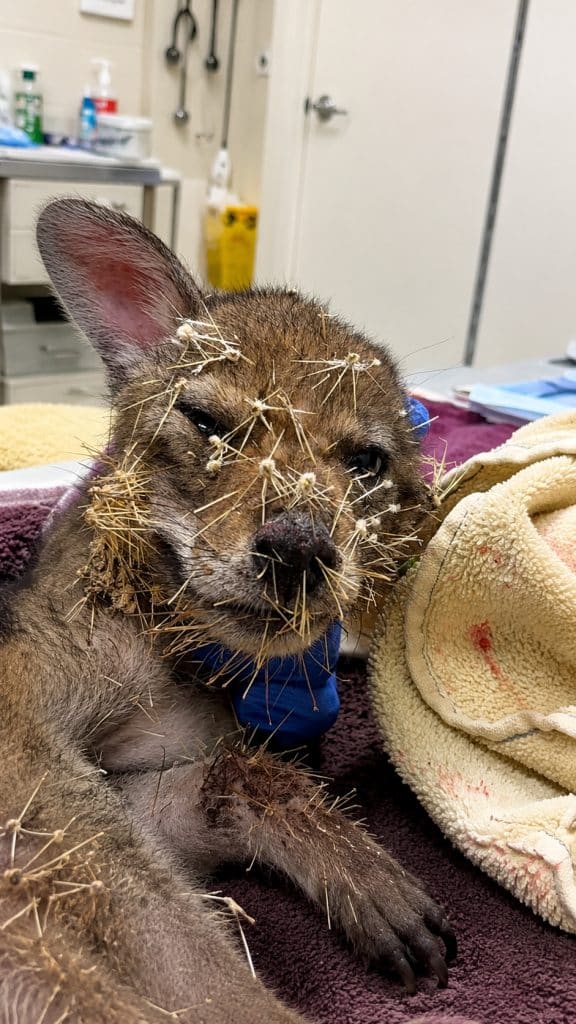
A tiny young coyote arrived at the Southwest Wildlife Conservation Center with his small body covered in sharp Cholla cactus spines.
They clung to his face.
His ears.
His belly.
His legs.
Even the area around his eyes was affected, leaving him so uncomfortable that he could barely open them.
He looked exhausted.
Confused.
And far too small to be facing so much pain alone.
Somewhere out in the wild, he had crossed paths with one of nature’s sharpest defenses. The cactus spines had attached to him in the worst possible way, turning every movement into discomfort.
By the time he reached the care team, he needed help immediately.
A Fragile Wild Life In Urgent Need
The staff knew they had to move carefully.
This was not a domestic puppy who understood human hands.
He was a wild animal.
Frightened.
Injured.
And overwhelmed by everything happening around him.
Before treatment could begin, the team gently weighed him so they could calculate the right amount of medication for his tiny body.
Every detail mattered.
Too little would not ease his pain enough.
Too much could place him at risk.
So they worked with calm focus, making sure the little coyote received the safest care possible.
He was then given sedation and pain relief, allowing his body to rest while the team began the difficult work ahead.
For the first time since becoming trapped in those painful spines, he no longer had to struggle through every touch alone.
VIDEO: Tiny Coyote Covered In Cholla Cactus Spines Is Gently Treated By Wildlife Rescuers
The Careful Work Of Removing Each Spine
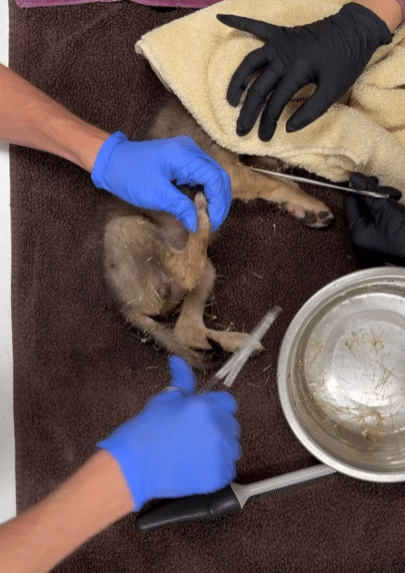
Once he was calm and comfortable, the medical team began removing the cactus spines one by one.
They used medical forceps and moved slowly, paying attention to every part of his small body.
The spines were everywhere.
Some were shallow.
Others had pierced deeply.
A few had gone through the delicate tissue of his ears, making the work even more careful and emotional.
There was no rushing this process.
Each spine had to be removed with precision.
Each movement had to protect the fragile skin beneath.
For more than 45 minutes, the team continued patiently, pulling out every sharp piece they could find.
It was quiet, focused work.
The kind of rescue that does not look dramatic from far away, but means everything to the animal lying on the treatment table.
Relief After The Pain
When the last visible spines were removed, the little coyote finally looked different.
His face was no longer hidden beneath painful cactus pieces.
His ears were free.
His body, though still sore, no longer carried the same terrible burden.
The team placed him into a warm, quiet incubator where he could recover safely.
Because he was young and frightened, they gave him a stuffed fox to rest beside.
It was a small comfort.
But for a baby wild animal suddenly separated from the world he knew, even a soft shape nearby could help him feel less alone.
Inside the warmth of the incubator, his body could begin to settle.
No sharp spines pulling at his skin.
No need to run.
No need to fight.
Only warmth, quiet, and the first steps toward healing.
Helping His Small Body Recover
The little coyote also needed fluids.
After spending time injured in the wild, his body had become dehydrated and stressed.
The team gave him subcutaneous fluids, gently helping restore what he had lost.
Recovery after a rescue like this is not only about removing what caused the pain.
It is also about helping the body regain strength.
Hydration.
Warmth.
Rest.
Careful monitoring.
Each part mattered.
The staff watched him closely as he began waking from sedation, making sure he remained stable and comfortable.
Slowly, his eyes became more alert.
His face, once tight with pain, began to show signs of life again.
He was still tired.
Still fragile.
But he was no longer trapped beneath hundreds of cactus spines.
The First Signs Of Life Returning
As time passed, the young coyote became more aware of his surroundings.
His eyes looked clearer.
His body seemed calmer.
He began responding more naturally to the quiet space around him.
Then came one of the most hopeful moments.
He was offered his first meal.
For a wild baby recovering from such a painful experience, eating was an important sign.
It meant his body was beginning to feel safe enough to focus on nourishment.
It meant strength could begin returning.
It meant the little coyote had made it through the most difficult first stage of care.
Every small improvement carried meaning.
A brighter look.
A steadier body.
A willingness to eat.
These were the quiet signs that healing had begun.
A Before And After That Said Everything
The video’s final comparison showed just how far he had come.
At first, he had arrived covered in Cholla spines, his little face nearly hidden, his eyes heavy with pain.
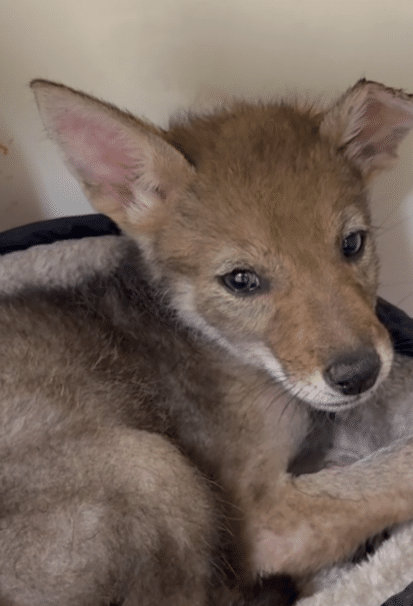
After treatment, he looked like a different animal.
Still delicate.
Still recovering.
But free from the sharp burden that had covered his body.
The transformation was not only physical.
It showed what careful wildlife rescue can do when people act with patience and compassion.
A tiny coyote who had been overwhelmed by pain was now resting in warmth, receiving fluids, food, and the chance to return to strength.
For the team caring for him, that was the goal.
Not to make him a pet.
Not to change who he was.
But to help him heal enough to one day return to the wild where he belongs.
A Wild Heart Given A Second Chance
This little coyote’s story is a reminder that wildlife needs compassion too.
Even animals born to survive in harsh places can face moments they cannot overcome alone.
A cactus can become a trap.
Pain can become too much.
A small body can need human help, even when that animal is meant to live free.
The people who cared for him understood that balance.
They handled him gently.
They treated his pain.
They gave him warmth without taking away his wildness.
And they prepared him for the life he was meant to return to.
The Hope Of Returning Home
Today, the young coyote is continuing to recover.
He is stronger than when he arrived.
His eyes are clearer.
His body is free of the hundreds of painful spines that once covered him.
There is still healing ahead, and the team will continue watching over him until he is ready for the next step.
But his story has already changed.
He is no longer the tiny animal nearly hidden beneath Cholla cactus spines.
He is a survivor.
A wild baby given care at exactly the right moment.
And with each day of healing, he moves closer to the future every wildlife rescuer hopes for:
A safe return to the open world.
Back to the land where he belongs.
Stronger, freer, and alive because someone cared enough to help.