When animal control workers pushed through a dense stretch of forest on a quiet day, they never expected to find a life hanging in the balance. Hidden among the trees was a small dog, barely moving, his body bound by a heavy leather belt that had been secured with a chain. He was alone, exhausted, and frighteningly thin. That moment marked the beginning of a long journey—one that would test patience, compassion, and the quiet power of consistent care.
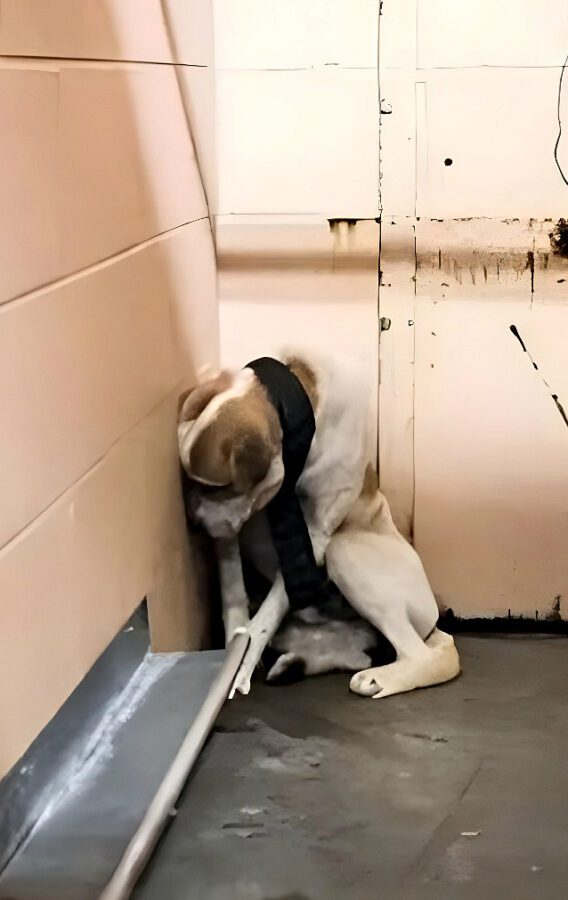
The dog was later named Stephen, a gentle name chosen to remind everyone involved that he was more than what had been done to him. At first glance, it was clear he had been without proper care for a long time. His ribs showed, his coat lacked shine, and his eyes carried a distant, guarded look. Nothing about him suggested comfort or safety. Those who found him understood immediately that whatever his past held, it had not been kind.
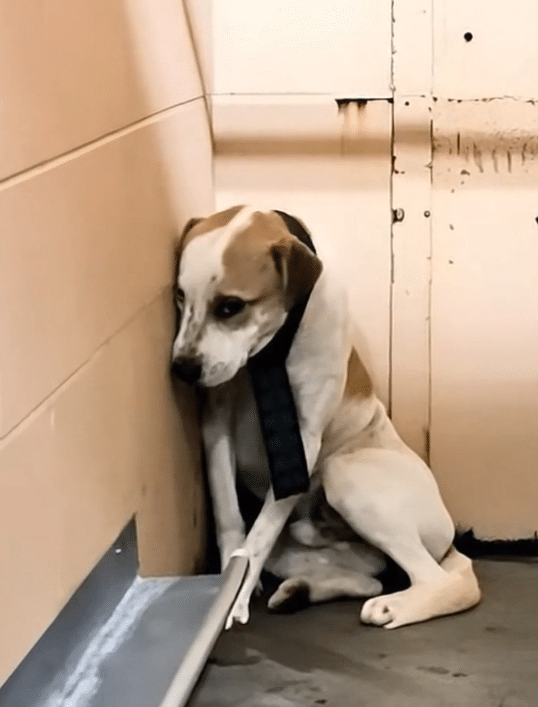
Stephen was transported to a local shelter, where the true depth of his emotional wounds slowly became visible. During his first days there, he stayed pressed into the farthest corner of his enclosure. He avoided eye contact, flinched at movement, and trembled whenever someone came too close. Any attempt at gentle interaction ended the same way—with a low warning sound and Stephen retreating deeper into himself. It wasn’t aggression born of anger; it was fear shaped by survival.
Volunteers who spent time observing him quickly realized how fragile his trust was. One admitted she felt hesitant approaching him, not because she believed he wanted to hurt anyone, but because his fear was so intense it felt like it might overwhelm him. Another volunteer noted that Stephen’s reactions made sense for an animal that had likely learned that restraint and isolation came before kindness. These behaviors weren’t flaws—they were shields.
The leather belt around Stephen’s neck was a constant reminder of his past. It limited his movement and seemed to weigh on him both physically and emotionally. Unfortunately, his fear made it impossible to remove it safely without medical help. After careful discussion, the team decided that sedation was the kindest and safest option, allowing veterinarians to fully examine him without causing further distress.
Video Stephen: A Story of Rescue and Restoration
During that procedure, the veterinary staff addressed more than just the belt. Stephen was dehydrated, undernourished, and depleted from weeks—or perhaps months—of neglect. Nutritional support began immediately, along with treatment tailored to rebuild his strength slowly. When the belt was finally removed, it felt symbolic to everyone present. It wasn’t just an object coming off; it was a chapter ending.
That moment became a turning point.
When Stephen woke up, something subtle yet profound had changed. Without the weight around his neck, he lifted his head and looked around with curiosity rather than fear. He allowed caregivers to sit nearby without retreating. Then, for the first time since his rescue, his tail moved—just a little, but enough to stop the room. It was a quiet signal that trust, though fragile, was beginning to grow.
From there, progress came in small, meaningful steps. Stephen began eating regularly, gaining strength day by day. Volunteers approached him slowly, speaking in calm voices and giving him space to decide when contact felt safe. He learned that hands could bring food, comfort, and reassurance. With each gentle interaction, his body language softened. His eyes brightened. The corner he once hid in no longer defined his world.
Healing didn’t happen overnight. Some days were harder than others. Loud sounds still startled him, and unfamiliar situations made him hesitate. But surrounded by patience and consistency, Stephen learned that safety could be predictable. He learned routines. He learned rest. Most importantly, he learned that he mattered.
One rescuer later reflected on the day the belt was removed, saying it felt like watching a door quietly open. That single act, combined with professional care and steady compassion, allowed Stephen to rediscover who he was beneath the fear. It proved that thoughtful decisions, made at the right time, can completely change the direction of a life.
Stephen’s story stands as a reminder that recovery is rarely dramatic. It’s built through calm mornings, gentle voices, and people who refuse to give up. With the support of dedicated volunteers and veterinarians, Stephen was given something he had never known before: the chance to feel safe.
Today, he continues to move forward, stronger in body and spirit. His journey shows that even when trust has been broken, it can be rebuilt. With patience, understanding, and care, wounds—both seen and unseen—can heal. Stephen’s life is proof that every dog deserves a second chance, and that hope often begins with one simple act of kindness.