There are moments when life shifts without warning.
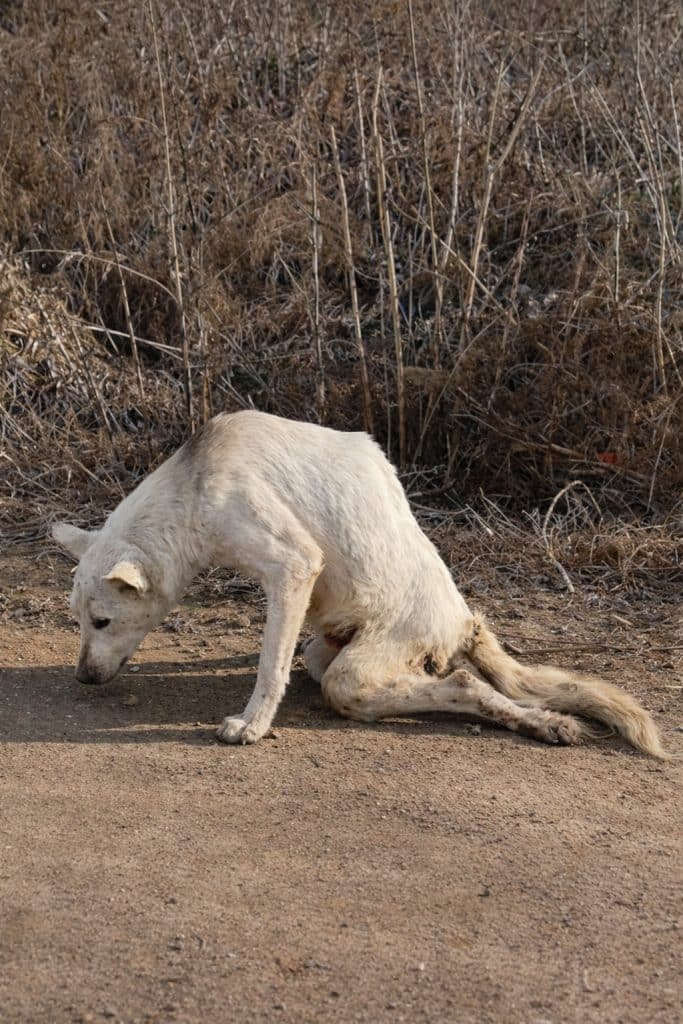
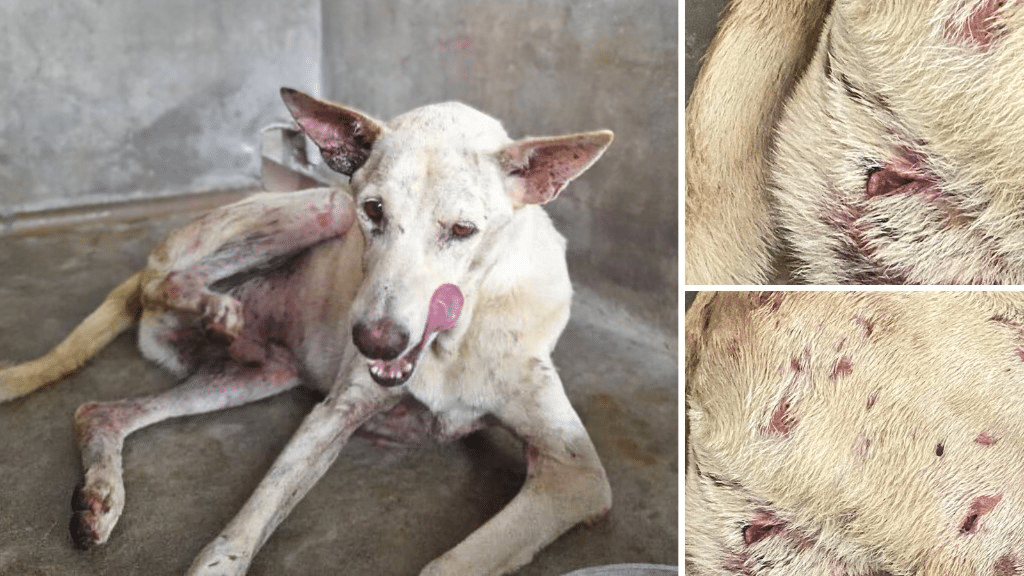
For Galina, that moment arrived on a busy road—under circumstances he never chose and could never understand. One second, he was moving through the streets the only way he knew how: alert, cautious, guided by instinct. The next, everything collapsed. A passing car struck him, and just like that, the fragile balance he had built to survive was gone. When the vehicle disappeared, Galina was left behind on the pavement—injured, frightened, and alone.
The damage was severe.
His spine had been badly injured, leaving his back legs unresponsive. Every attempt to move sent pain through his body. Still, driven by instinct, he dragged himself away from the road, inch by painful inch. There was no shelter waiting for him. No reassurance. Only the open street and the realization that his body no longer obeyed him.
For days, Galina survived however he could.
He rested for long stretches, conserving energy. Hunger followed him constantly, but the pain was worse. Each night carried uncertainty. Each morning demanded endurance. Dogs like Galina don’t understand statistics, but the reality was sobering: the likelihood of him ever walking again was estimated at less than ten percent.
Then someone stopped.
VIDEO: His Spine Was Broken, but His Spirit Was Not — How One Dog’s Life Was Rebuilt by Patience, Care, and Unconditional Love
A rescuer noticed the stillness, recognized the quiet suffering, and saw more than a broken body. Galina was lifted gently, placed into safety, and taken to a veterinary clinic where the full extent of his injuries could finally be addressed.
The diagnosis confirmed what everyone feared.
The spinal damage was serious. Recovery—if it came at all—would be long, uncertain, and demanding in every possible way.
But for the first time since the accident, Galina was not alone.
From the very beginning of his recovery, one thing stood out.
Galina had not given up.
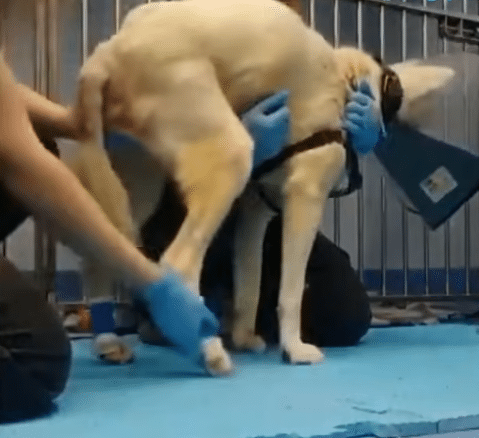
Lying on soft bedding, his eyes followed the people moving around him. There was fear, yes—but also curiosity. A quiet awareness that this place, these hands, might be different. Medical care began immediately. Pain management. Careful monitoring. Gentle routines that slowly replaced chaos with structure. His rescuer stayed close, speaking softly, building trust one calm moment at a time.
When it became clear that walking unaided might never return, a new chapter opened.
Galina was introduced to a wheelchair.
At first, it felt strange. The straps, the sounds, the unfamiliar balance. Movement required trust—not only in the device, but in the humans guiding him. Then something shifted. Once he realized the wheelchair allowed him to move freely again, Galina’s world expanded.
He could explore.
He could follow scents.
He could feel motion without pain.
The wheelchair did not represent loss.
It represented possibility.
Physical therapy became part of daily life. Stretching. Strength-building. Encouragement. Progress came slowly, measured in inches rather than milestones. Setbacks were unavoidable. At one point, Galina faced another major challenge—a neurological surgery that threatened to undo months of effort. Recovery from that procedure was exhausting, both physically and emotionally.
Still, he persevered.
So did his rescuer.
Nearly three years passed.
Three years of early mornings and late nights.
Three years of adapting routines and celebrating small victories.
Three years of choosing commitment, again and again.
And somewhere along that long road, Galina changed.
The dog once left helpless on the street became confident and expressive. Upright in his wheelchair, his posture reflected pride rather than pain. His eyes lit up when familiar voices called his name. He learned how to navigate new spaces, how to play, how to rest without fear.
Joy returned.
Not because his body became perfect—but because his life became full.
Today, Galina moves through the world with purpose. His wheelchair, once a symbol of injury, now stands as proof of resilience and adaptation. It tells a story not just of survival, but of what becomes possible when patience and love refuse to give up.
His rescuer often says Galina taught them as much as they taught him.
He showed that healing isn’t about returning to who you were before—it’s about discovering who you can become with support. That love is measured not by outcomes, but by consistency. And that second chances are built slowly, through care, patience, and unwavering belief.
Galina’s life is no longer defined by what he lost on that road.
It is defined by what he gained afterward.
Safety.
Trust.
Movement.
Belonging.
And most of all—love.
His journey reminds us that even when the odds are small, they are never zero when compassion steps in. Sometimes, all it takes to change a life is one person willing to stay long enough for healing to happen.