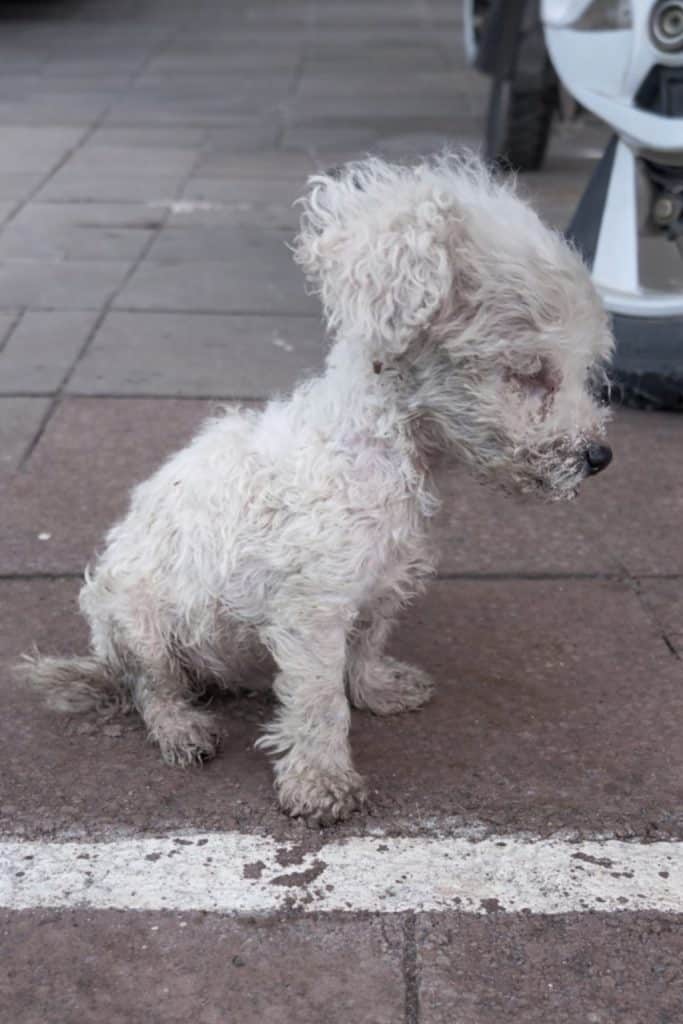
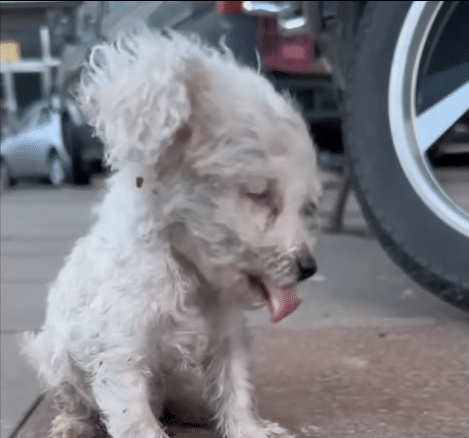
We first noticed him on a busy street, where life moved quickly and without pause. In the middle of it all was a tiny white puppy, turning slowly in circles on the pavement. Cars passed close by, people walked past without stopping, yet he seemed locked inside a world of confusion. It didn’t take long to understand why—this little puppy could not see.
His body showed signs of hardship far beyond his age. He was painfully thin, weakened by hunger, and trying to chew on a small rock as if it were food. It was a heartbreaking sight. Blind, alone, and fragile, he had no way to protect himself in a world that offered him no guidance.
We brought him home, unsure of what the future would hold. He circled constantly, bumped into objects, and reacted nervously to unfamiliar sounds. At first, we feared something neurological might be wrong. But as we looked closer, the truth became clear. This wasn’t an injury. This was how he had entered the world. He had likely been blind since birth.
Perhaps that was why he had been left behind.
After his first bath, a quiet surprise emerged. Beneath the dirt and exhaustion was a soft, snow-white puppy with delicate features and an innocent expression. He was beautiful in a way that felt almost fragile. Still weak, he tried to walk, stumbled, and fell—again and again—never frightened, only confused, as if the world kept shifting beneath him.
VIDEO: Born Without Sight, But Never Without Hope – How a Blind Puppy Found His Way to Love
A full veterinary examination confirmed congenital blindness. His optic nerves had never developed. His delayed responses weren’t signs of weakness, but signs of inexperience. He had never been taught to trust sound, touch, or human presence. He didn’t even have a name.
That changed immediately. We named him Ango.
From that moment on, Ango was no longer just a blind stray. He was someone. He mattered. We began guiding him gently with our voices—soft tones, repeated words, calm reassurance. Slowly, he started to recognize footsteps, familiar movements, and the comfort of routine. The constant spinning slowed. His body finally learned how to rest.
Ango couldn’t find food on his own at first, but the way he drank warm milk with eager trust melted every heart in the room. We created a quiet, predictable space for him—soft bedding, familiar scents, padded corners. No sudden changes. Just safety. For the first time, Ango was allowed to simply be a puppy.
Day by day, he grew stronger. Around the tenth day, he found his voice, protesting softly when he wanted attention. By the eighteenth day, his sense of smell sharpened enough for him to locate food on his own—a major milestone. By the thirtieth day, he could walk steadily, returning again and again to a favorite pillow that became his personal landmark.
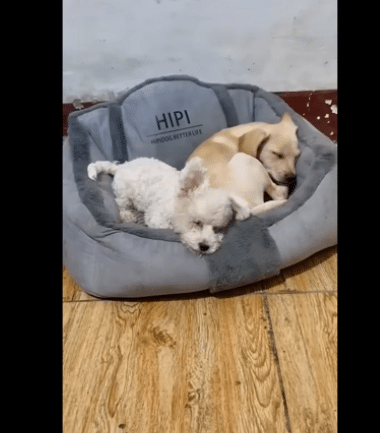
By the fifth week, Ango’s personality truly emerged. He bonded deeply with another dog, sharing naps, guarding quietly, and following closely wherever his friend went. He became alert, curious, and surprisingly brave—the first to react to new sounds, the first to check in when something changed.
Three months later, Ango was unrecognizable from the puppy we had first met on the street. He enjoyed gentle walks, feeling grass beneath his paws and air on his face. He navigated the world through scent, sound, and touch—guided not by sight, but by trust.
Ango is gentle.
Ango is brave.
Ango is whole.
He proves that being different does not mean being broken. Given patience, structure, and love, he didn’t just survive—he flourished. Ango may never see the world, but he experiences it fully. And in every careful step he takes, he reminds us that hope does not depend on sight, only on compassion.