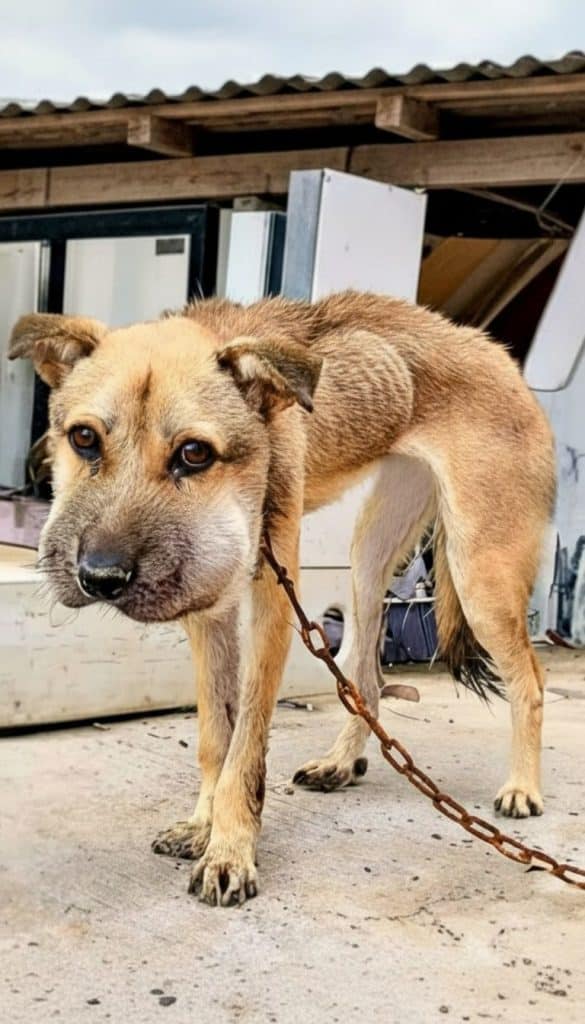
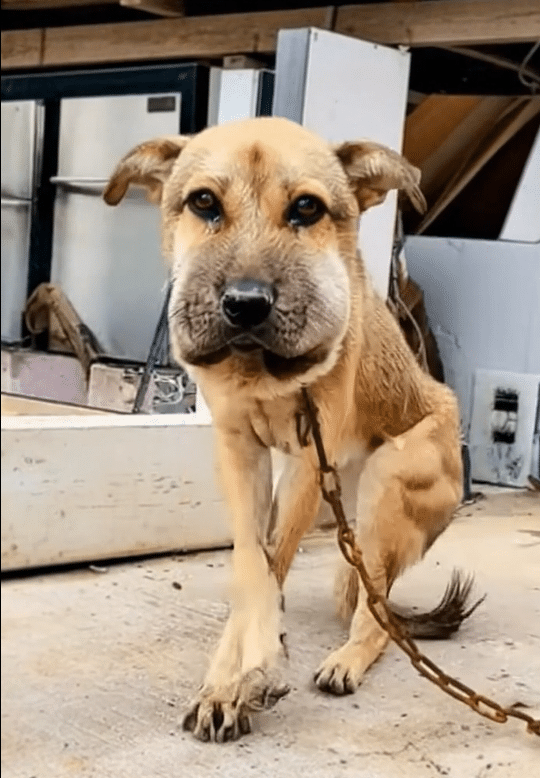
For a long time, Rudy stood quietly at the edge of a concrete doorway, almost blending into the shadows around him.
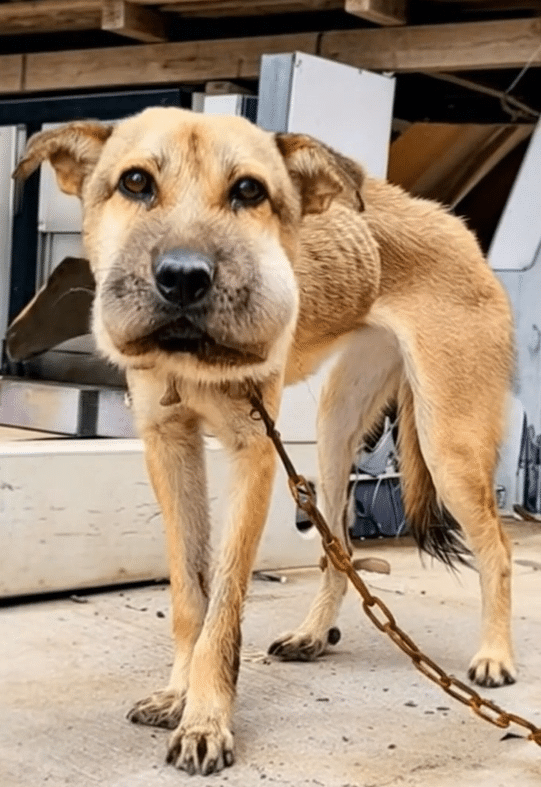
A heavy, rusted chain wrapped tightly around his neck, pressing into skin that had long stopped healing. Every movement caused discomfort. Even standing still required effort. His face was swollen and uneven, shaped by pain that had gone untreated for far too long. People noticed—but only briefly. Most looked away, choosing not to see what was right in front of them.
Nearby sat a plastic bowl filled with cloudy water and a piece of stale bread tossed beside it. Hunger followed him every day, but pain followed more closely. Eating hurt too much, so he endured both in silence. The small yard around him was cluttered with broken objects and sharp edges. There was nowhere to rest comfortably. Lying down made the pressure worse, so Rudy learned to sleep standing up, eyes half-closed, body worn thin by exhaustion.
When Suffering Becomes Invisible
To those who passed by, Rudy became part of the background.
He was known simply as “the red dog on the chain.” A familiar sight. An uncomfortable one—but familiar enough that people stopped questioning it. Over time, his hardship blended into daily routine. And when suffering lasts long enough, it often fades from attention.
His owner appeared only occasionally. When he did, it was brief and detached. Food tossed into the bowl. A sharp word if the chain tangled. Sometimes a careless nudge with a foot. There was no loud cruelty, no dramatic anger—just steady neglect. To that man, Rudy wasn’t a life with fear and needs. He was an object occupying space.
And then, one evening, someone stopped.
VIDEO: From Chains to Chance – Rudy’s Quiet Journey Back to Life
The Moment Someone Finally Looked
A woman paused at the gate and looked into the yard.
She didn’t turn away. She saw the swelling. The chain. The posture of an animal who had learned not to expect anything. But she also noticed something quieter—a fragile awareness in his eyes, a small thread of hope that hadn’t completely broken.
She stepped inside and gently placed a clean bowl on the ground. Fresh water caught the light. Rudy hesitated as the chain rattled softly. He tried to drink but pulled back when pain flared. Still, he tried again. By the third sip, something shifted. Relief—small but real—replaced fear.
Compassion Stepped In Where Neglect Had Ruled
The woman stayed.
She spoke softly, even though Rudy didn’t understand the words. Her presence alone mattered. With shaking hands, she sent messages to volunteers, sharing photos and location, explaining his condition as clearly as she could. The response came quickly. Help was on the way.
When the owner appeared, he seemed more annoyed than concerned. He dismissed her worries with a shrug, treating Rudy’s condition like an inconvenience. But the decision had already been made. Compassion had entered a space long ruled by indifference.
Soon after, volunteers arrived. The sound of metal cutters breaking through the chain echoed across the yard. When the tension finally released, Rudy wobbled, unsteady without the weight he had carried for so long. He didn’t fall—because someone held him.
For the first time in his life, his neck was free.
A Quiet Beginning to Healing
At the veterinary clinic, everything felt different.
The air was calm. The movements were gentle. The doctor examined Rudy carefully, speaking with steady reassurance. The road ahead wouldn’t be easy—but there was time. There was hope.
That night passed slowly. Soft lighting replaced harsh shadows. Gentle hands replaced fear. By morning, the swelling had already begun to ease. A simple smile from the veterinarian said everything.
He was going to make it.
They named him Rudy.
Learning What Care Feels Like
Recovery came in small, meaningful steps.
A soft blanket instead of concrete. Clean water whenever he needed it. Meals that didn’t hurt to eat. For the first time, Rudy could rest without checking for the weight of a chain. Pain faded gradually, leaving behind scars that told a story—but no longer controlled his life.
As days turned into weeks, trust began to grow. An open hand. A calm voice. A leash that guided instead of restrained. On short walks, the world opened up—sunlight on his fur, new scents, and people who learned how to approach him gently.
At checkups, the vet noted steady progress. His face would never be perfectly symmetrical again, but that was okay. Healing doesn’t erase the past. It makes room for the future.
A Life Worth Noticing
Sometimes, the woman looks back at the photos from that first day.
They remind her why she stopped. Why she stayed. Why she made the call. Those images were never erased—they became proof of what kindness can change.
Now, Rudy sleeps peacefully nearby. When he’s content, his smile tilts just slightly, a quiet reminder of how far he’s come. And in that gentle expression lives a simple truth:
Every life is worth noticing.
And every act of compassion matters.