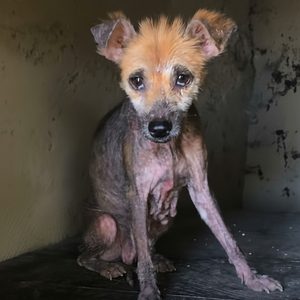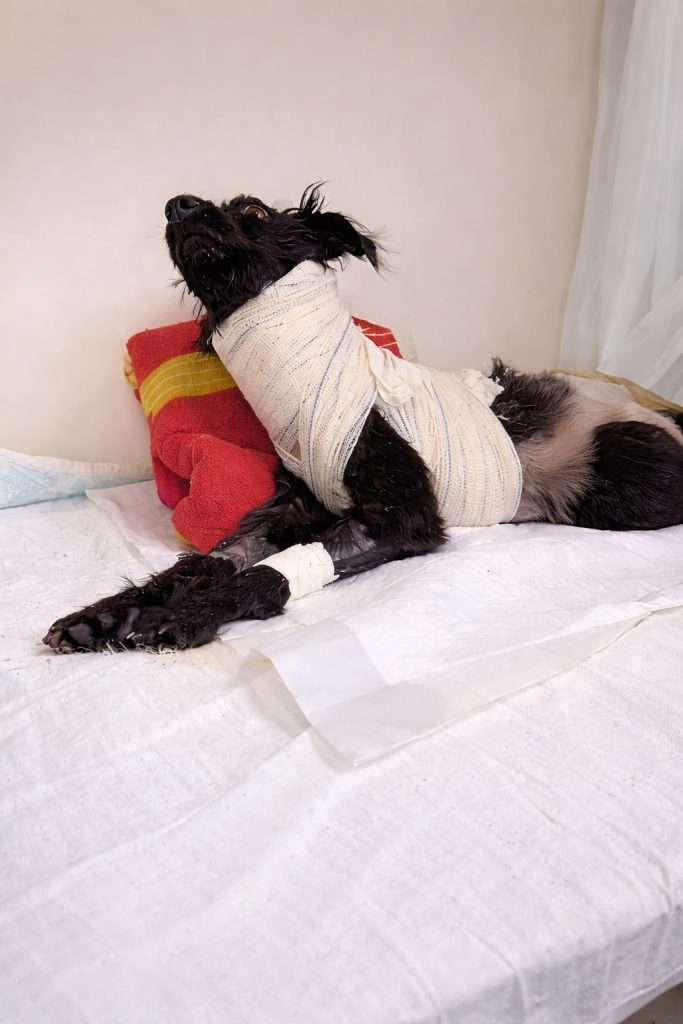
Aurora was found on the side of a quiet dirt road, so motionless that she almost disappeared into the dust beneath her. Her body lay flat against the ground, not struggling, not resisting—simply still. To someone passing by, she might have looked like a dog resting. But one glance at her eyes told a different story.
They followed every movement carefully.
There was no panic in them. No fear. Just a silent question that lingered longer than words ever could.
When the Body Gives Up but the Mind Stays Awake
Aurora showed no visible injuries. Her coat was clean, her body well-kept. She wasn’t emaciated or neglected in the way rescuers often see. Yet when they gently tried to help her stand, the truth revealed itself.
Her legs didn’t respond.
All four limbs remained still, disconnected from her will. Only her head moved slightly. She blinked. She watched. She was fully aware—trapped inside a body that no longer obeyed.
Video: She Looked at Me With Eyes That Asked, “Why Bother Saving Me?”
Searching for Answers That Wouldn’t Come Easily
Veterinary teams moved quickly. X-rays were taken. Her spine showed no fractures. No breaks. No clear nerve damage. Test after test followed, each ruling out another explanation.
There was sensation in her legs—faint reactions when touched—but no control.
Her mind knew what to do.
Her body simply couldn’t follow.
As days passed, uncertainty weighed heavily. Without a diagnosis, difficult conversations began. Some questioned whether continuing treatment was fair. Without movement, without answers, they wondered if letting go might be kinder.
But Aurora’s caregivers couldn’t ignore what machines couldn’t measure.
Why They Refused to Walk Away
Aurora was alert. She followed voices. She leaned subtly into gentle touch. Her eyes held focus, awareness, and something deeper—presence. This wasn’t a dog fading away. This was a dog still holding on.
Walking away would have been easier.
Staying meant uncertainty.
They chose to stay.
A Different Possibility Emerges
Their refusal led them to a neurologist experienced in complex cases. He didn’t rush. He listened. He examined Aurora carefully, from the beginning—not the end.
His conclusion shifted everything.
The issue might not be in her spine at all. It could be in her brain—pressure interfering with the signals meant to reach her body.
For the first time, there was a direction.
Choosing Hope Without Guarantees
That possibility opened the door to brain surgery.
There were no promises. No certainty. The procedure could help, change nothing, or carry risks of its own. But it offered something Aurora hadn’t had since the day she was found.
A real chance.
The surgery was performed with care. When Aurora woke, the change wasn’t dramatic—but it was real. She seemed calmer. The quiet discomfort that once filled her body had eased. Her legs still didn’t move, but the pain that shadowed her days was gone.
It wasn’t a miracle.
It was a turning point.
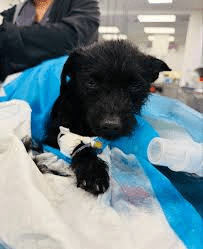
Healing Measured in Moments, Not Steps
Recovery moved slowly. Physical therapy kept her muscles engaged. Gentle voices filled her days. Caregivers stayed close, offering consistency instead of pressure.
Progress came in whispers.
A stronger lift of her head.
Eyes that lingered longer.
A deeper awareness of the world around her.
Then one day, something happened.
The Smallest Movement That Meant Everything
One of Aurora’s hind legs twitched.
It was brief. Easy to miss. But it changed everything.
That tiny movement was proof her body hadn’t given up. Her nervous system was still trying. From that moment on, every small sign became a victory.
A Life Defined by Presence, Not Limitations
Aurora didn’t transform overnight. But her spirit did.
She became more engaged. More trusting. Her tail began to move faintly. Her eyes softened. She responded to touch not with fear—but with acceptance.
Most importantly, she was no longer alone.
Her caregivers stopped measuring her worth by what she could or couldn’t do. They measured it by who she was—aware, gentle, resilient.
Why Aurora’s Story Matters
Aurora’s journey reminds us that not all rescues are dramatic. Some unfold quietly, through patience and presence. Some victories don’t come with guarantees—only commitment.
She represents countless animals whose paths are harder to understand and easier to abandon.
Today, Aurora is safe. She is cared for. She is loved.
Her future continues one gentle moment at a time—but one truth is certain: she will never again lie alone, wondering if she was worth saving.
Sometimes, the most powerful rescue isn’t about fixing everything.
It’s about choosing not to walk away.