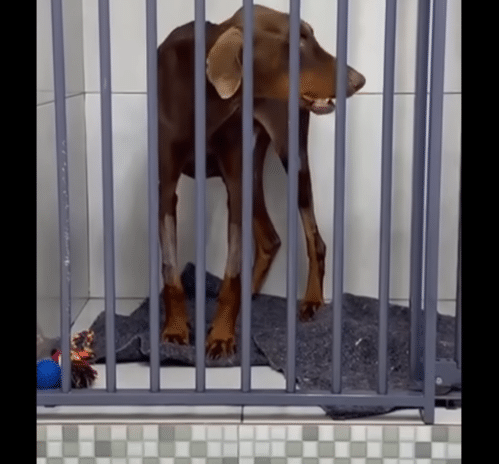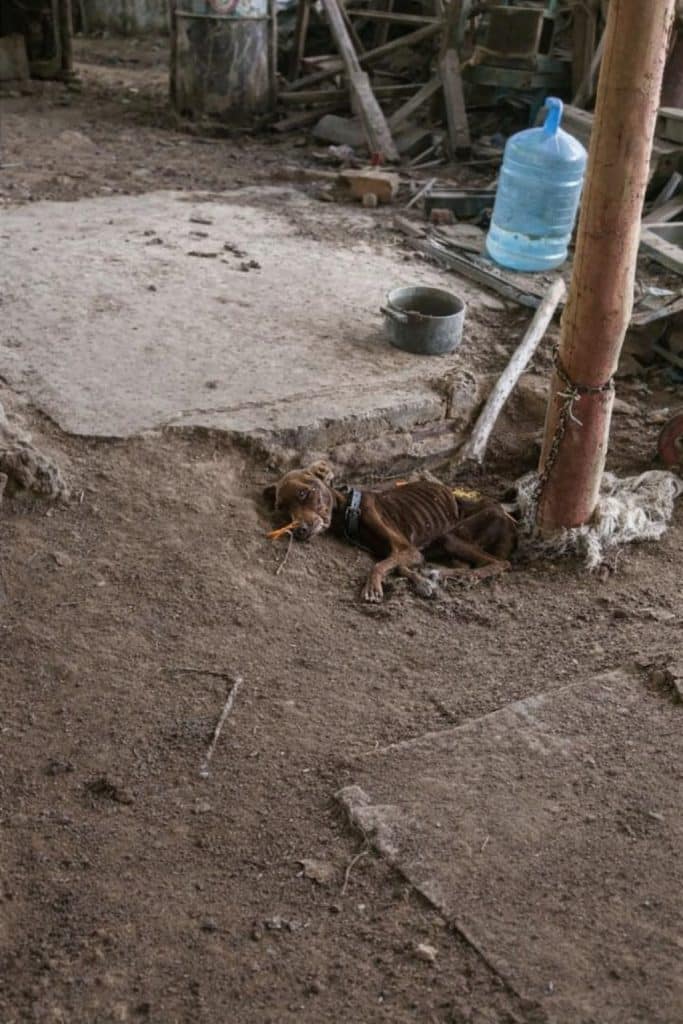
The rescue began in silence, inside a pet shop that had long been abandoned. The building was empty, dusty, and filled with the echo of neglect. It was only after rescuers followed faint cries for help that they realized someone was still there. Inside, they found a Doberman chained tightly to a post. His body was painfully thin, reduced almost to skin and bone. He could not stand. He did not try to move. It was as if he had already accepted that no one was coming.
Later, he would be given the name Bono.
As rescuers looked around, the situation revealed itself to be even more heartbreaking. Bono was not alone. There were seven dogs in total, all left behind without food, water, or care. Authorities were immediately contacted, and the former owner admitted abandoning them due to an inability to continue operating the shop. Legal action followed, but for Bono, the focus was no longer on the past. It was on survival.
A body pushed beyond its limits
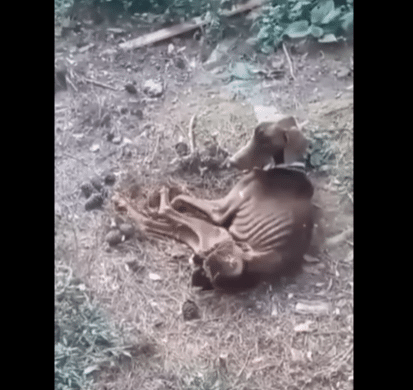
Bono was rushed to a veterinary clinic in critical condition. His diagnosis was severe: extreme dehydration, total exhaustion, a large infected wound, and a body weakened by prolonged neglect. He was too weak to eat on his own and could barely respond to his surroundings. Fluids were administered, wounds were carefully cleaned, and tests were performed to understand just how fragile his condition had become.
In those first days, Bono lay almost motionless. His eyes were tired, yet when doctors gently touched him, he made small efforts to respond. It was a quiet sign that he was still present. Still fighting. Still holding on.
Video: Bono’s Incredible Rescue and Miraculous Recovery Journey
Days defined by uncertainty
The following days were the hardest. Infection spread quickly, and Bono’s blood levels remained dangerously low. His condition stayed critical longer than anyone had hoped. Recovery was never guaranteed. But the veterinary team refused to give up. They fed him slowly, offering tiny portions by hand. Physical therapy began gently, focused only on keeping his body responsive.
Progress came slowly. Almost imperceptibly. Bono became more alert. He began to eat on his own. One day, he managed to sit up, his body shaking under the effort. It wasn’t much, but it was enough to bring cautious hope.
When survival turns into recovery
Then, something changed.
Weeks into treatment, Bono took his first steady steps. Soon after, he was standing on his own, feeling grass beneath his paws for the first time in who knows how long. His weight told the story clearly. From just 19 kilograms when he was rescued, Bono had grown stronger, eventually reaching more than 37 kilograms.
Muscle returned. His coat regained its shine. Most importantly, his eyes changed. Where there was once emptiness, there was now focus, curiosity, and life.
A future once thought impossible
When Bono was finally healthy, the next chapter began. A family with a big heart welcomed him into their home. He now lives in a spacious house with a garden, surrounded by care and stability. He plays gently with a young child, gets along peacefully with other dogs, and enjoys long walks—sometimes even running freely along the beach.
The image of Bono chained to a post feels distant now. In its place is a dog who belongs.
What his journey reminds us
Bono’s story is often described as a miracle. But miracles are rarely sudden. They are built through patience, commitment, and compassion. Through people who refuse to walk away. Through support from those who believe that no life is disposable.
From abandonment and the edge of death to safety, love, and freedom, Bono’s journey stands as proof that second chances are real. And when given the opportunity, even the most broken bodies can heal.
Today, Bono is no longer surviving.
He is living.