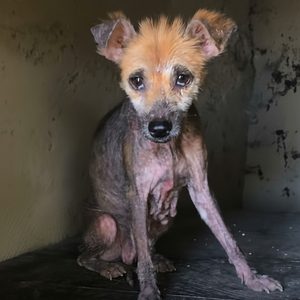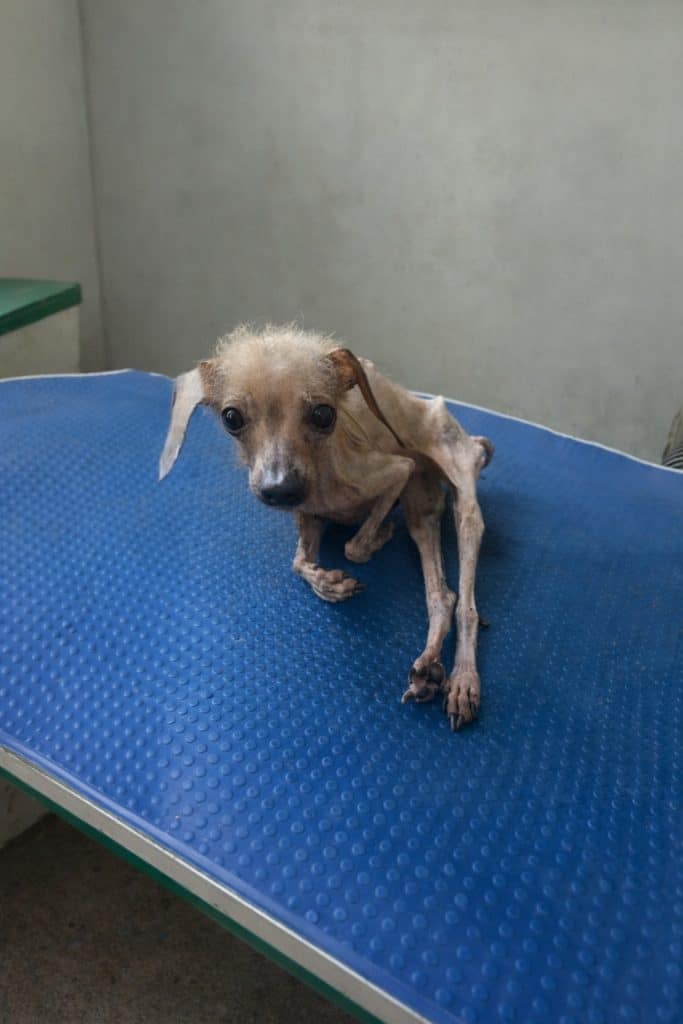
When Tootsie was first rescued, she was barely more than a shadow of a puppy.
She had been pulled from a truck transporting dogs to a slaughter facility — one small body among many, crowded together in fear and uncertainty. By the time she arrived at safety, she weighed only 2.5 kilograms. Her tiny frame trembled with exhaustion.
Her ears were badly infected.
Her skin was inflamed from a severe parasitic condition.
Her body showed clear signs of long-term neglect.
She was so weak she couldn’t bark.
She couldn’t run.
She couldn’t even eat on her own.
The world had asked too much of her fragile body.
Fighting Illness While Barely Holding On
Soon after her rescue, another threat emerged.
Tootsie tested positive for distemper — a dangerous infectious disease, especially for a puppy whose immune system was already compromised. The veterinary team moved carefully, knowing that every hour mattered.
But there was more.
X-rays revealed degenerative changes in her spine. Bone spurs had formed along her vertebrae, causing stiffness and severe discomfort. Her back legs were rigid, unable to support her weight. She could not stand on her own.
Even resting seemed uncomfortable.
At night, she would cry softly — not loudly, just enough to remind caregivers that the pain was still there. She was given daily medication to ease her discomfort and began a long course of careful treatment.
Video: Rescued From a Slaughter Truck, She Couldn’t Even Stand — But Watch What Happens Next
The Gentle Work of Healing
The medical team began with her skin.
Her fur had to be carefully shaved to properly treat widespread infection. Medicated baths, ointments, and patient hands replaced the filth she had endured before.
Because of her spinal condition, traditional exercise wasn’t possible. Instead, she began a rehabilitation plan that included acupuncture and assisted mobility therapy. A supportive harness helped hold her body upright while she attempted small movements with her back legs.
There was no rushing her recovery.
Each session was measured in inches, not miles.
Each improvement was celebrated quietly.
Pain management remained essential. Her caregivers monitored her closely, adjusting treatment so she could rest more comfortably and rebuild strength.
Learning How to Eat — And How to Hope
At first, Tootsie couldn’t eat on her own.
She was offered milk from a bottle, but even that was difficult. Her body lacked the strength and coordination. The team fed her patiently, ensuring she received the nutrition she desperately needed.
Then, after nearly a week of quiet perseverance, something shifted.
One morning, she leaned toward her bowl.
She sniffed.
And she began to eat on her own.
It wasn’t dramatic. It wasn’t fast.
But it was a turning point.
Her body was beginning to respond. Her will to live was stronger than anyone had dared to hope.

The First Unsteady Steps
Standing seemed impossible at first.
Her legs were stiff. Her balance uncertain. But supported gently by rehabilitation equipment, Tootsie began attempting small weight-bearing movements.
She would try.
Fall.
Rest.
And try again.
Then came the day that brought tears to more than one pair of eyes.
Tootsie pushed herself up — shakily, carefully — and took a few short steps.
They weren’t perfect.
But they were hers.
Those first steps marked the beginning of something extraordinary: not just physical recovery, but resilience.
A New Chapter Among Survivors
After completing her quarantine and intensive treatment, Tootsie was moved to the main rescue center.
There, she met other dogs who had also survived transport trucks and hardship. For the first time, she was surrounded not by fear, but by companionship.
She no longer faced the world alone.
She received gentle affection. Warm bedding. Nutritious meals. And above all, time — time to continue healing at her own pace.
Her body still requires ongoing care. Her spine will always need attention. But she now walks — slowly, steadily — toward a future that once seemed impossible.

What Tootsie’s Journey Teaches Us
Tootsie’s story is not about tragedy.
It is about endurance.
It is about the quiet strength animals carry, even when their bodies are frail.
And it is about the power of patient, compassionate care.
She was once too weak to bark.
Today, she stands — not just on her legs, but in the hearts of those who fought for her.
Because sometimes survival isn’t loud.
Sometimes it begins with something as small as a puppy choosing to eat from her bowl… and refusing to give up.