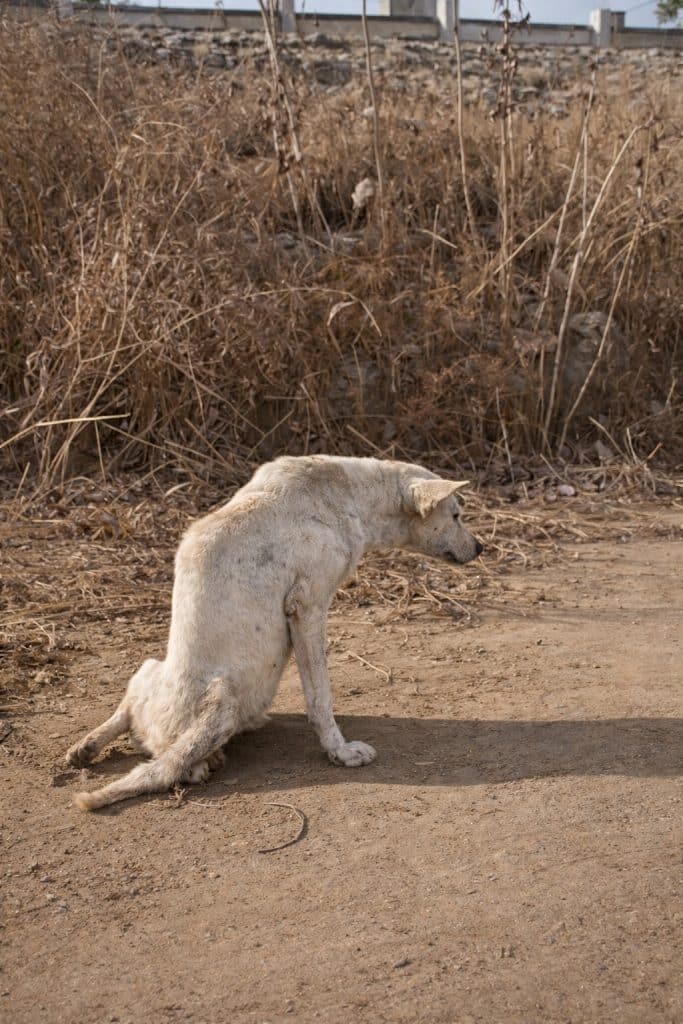
In Astrakhan, Russia, a white dog was struck by a car.
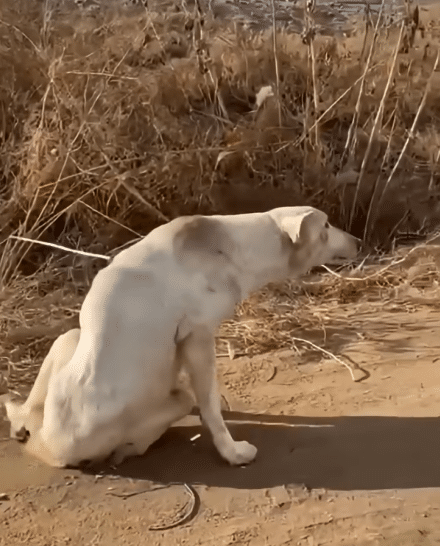
The accident left him with severe spinal injuries. His back legs no longer responded. Instead of receiving help, he was left where he fell — alone on the street.
For days, he survived by dragging himself forward using only his front legs. Each movement was slow. Each meter covered required enormous effort.
He searched for scraps of food.
He avoided passing vehicles.
He endured cold nights without shelter.
The world moved around him.
He simply tried to survive within it.
A Chance Encounter That Changed Everything
Galina, who runs an animal rescue shelter, eventually saw him.
At the time, she was already caring for hundreds of animals. Resources were stretched. Space was limited.
But she could not ignore him.
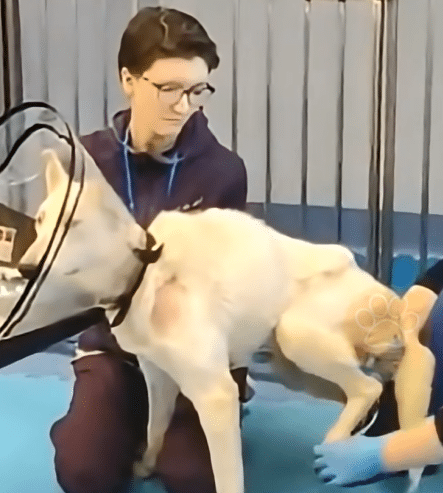
He was transported to a veterinary clinic for immediate examination.
The diagnosis was serious:
A fractured spine.
Complete paralysis of the hind legs.
Multiple untreated wounds.
The prognosis was uncertain.
But surrender was not part of the plan.
The transformation begins not with movement, but with care.
Video: Paralyzed After a Car Accident — He Learns to Run Again on Snow
The Long Road to Stabilization
The first stage of recovery focused on survival and stabilization.
His wounds were cleaned and treated.
Bladder function had to be carefully managed.
Daily physiotherapy began almost immediately.
Volunteers massaged his hind legs to stimulate circulation and preserve muscle tone. Acupuncture sessions were introduced to encourage nerve response. Every day required consistency.
Progress was slow.
Sometimes invisible.
But the team remained steady.
To improve his chances, volunteers made the decision to transport him from Astrakhan to Moscow, where advanced rehabilitation therapies were available.
It was a long journey — but an important one.
Learning to Move in a New Way
In Moscow, he received a custom mobility cart designed specifically for dogs with paralyzed hind legs.
The first attempts were uncertain.
He hesitated.
He leaned awkwardly.
He had to relearn balance entirely.
But he did not resist the device.
Gradually, he began to understand how to use it.
With practice, his movements grew smoother. The cart didn’t replace his back legs — it supported his independence.
For the first time since the accident, forward motion felt natural again.
From Survival to Joy
The final scenes of the video show him running across snow-covered ground.
The cart glides behind him as he propels himself confidently with his front legs.
His posture is upright.
His ears alert.
His expression bright.
He is no longer dragging himself along pavement.
He is moving with purpose.
A Story Beyond Injury
This story is not about erasing what happened.
His spinal injury remains.
His paralysis remains.
But so does his life.
Galina and the volunteers did not change the past — they changed the outcome.
Where there was abandonment, they offered commitment.
Where there was immobility, they provided adaptation.
Where there was isolation, they created support.
The video leaves us with a simple truth:
Compassion cannot undo an accident.
But it can rewrite what comes next.
A dog once left helpless on the streets of Astrakhan now runs across snow in Moscow — carried forward not by his back legs, but by care, innovation, and unwavering kindness.