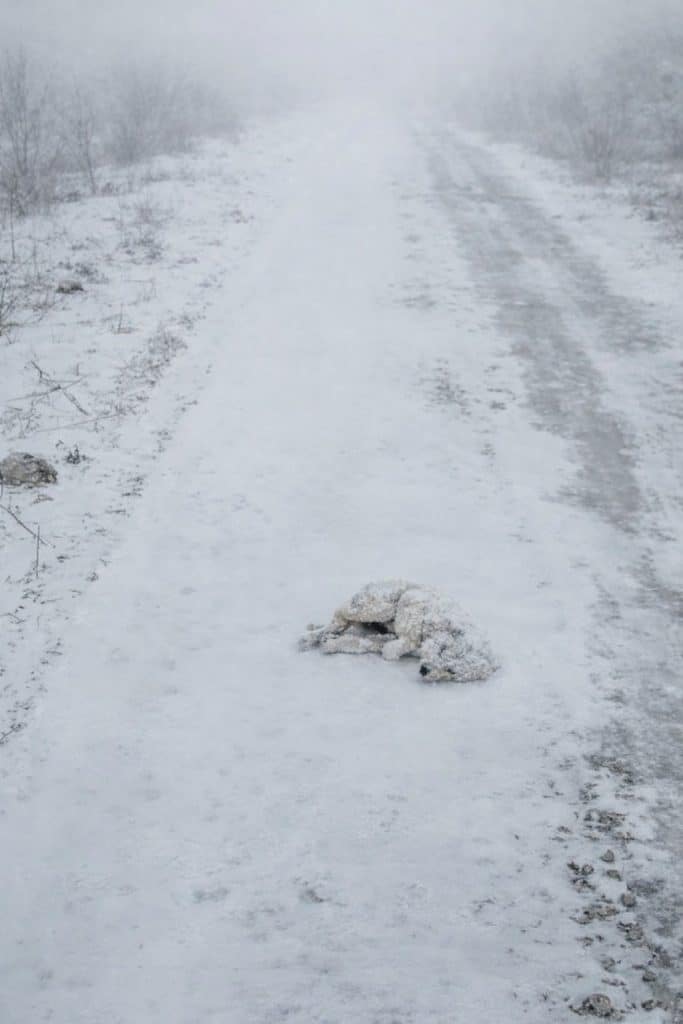
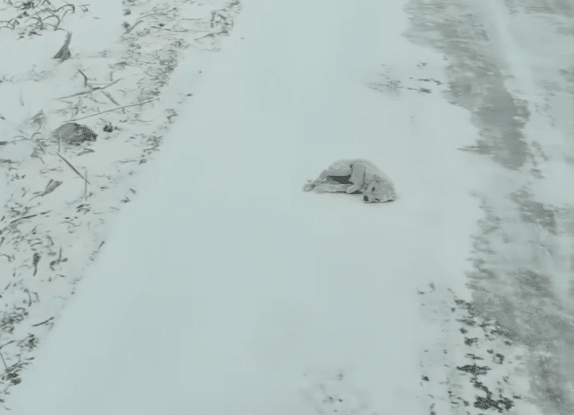
Snow had fallen heavily through the night.
By morning, the road was blanketed in white, silent and still. That was when a man driving carefully through the storm noticed something unusual ahead — a small shape barely visible against the snow.
At first, it didn’t even look like a living being.
It looked like a lump of ice.
As he slowed down and stepped out of his car, he saw the truth. A tiny white puppy lay motionless in the thick snow. His fur was stiff with frost. Snow clung to his body as if trying to claim him entirely.
He looked gone.
But when the man knelt beside him, something stopped him from walking away.
The faintest breath.
The puppy was still alive.
Without hesitation, the man gently lifted the frozen body into his arms and carried him to the warmth of his car. There was no time to wonder how he had ended up there. No time for questions.
Only action.
Because sometimes, compassion doesn’t wait for explanations.
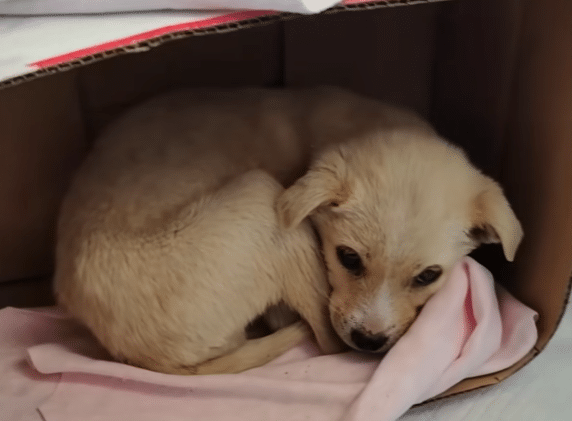
Back at home, the man acted quickly. He built a strong fire to raise the room’s temperature and prepared a simple space near the warmth. A cardboard box lined with soft towels became a temporary refuge.
The puppy’s body was rigid from the cold.
Video: Found Frozen in the Snow, He Took His First Warm Breath Beside the Fire
His movements were barely noticeable — a slight twitch of a paw, a faint shift of his head. His small chest rose slowly, as though each breath required effort.
The man stayed close, monitoring him carefully. Warming a body that has been exposed to extreme cold requires patience. Too fast could cause shock. Too slow could cost precious time.
So he sat beside the box.
Waiting.
Watching.
Hoping.
After his body temperature began to stabilize, the man brought him to a veterinary clinic for further care.
The medical team worked gently and efficiently. Fluids were administered to rehydrate him. His vital signs were monitored closely. The focus was not dramatic — it was steady recovery.
Small steps.
Warmth.
Hydration.
Rest.
The first day passed quietly.
By the second day, there were subtle changes. His eyes opened more fully. His breathing became stronger. He responded to soft voices and gentle touch.
On the third day, something remarkable happened.
He stood.
Wobbly. Unsure. But standing.
It wasn’t a dramatic leap or playful run. It was a slow, careful lift of a body that had nearly surrendered to the cold.
From there, progress unfolded quickly.
He began eating small portions of food. He explored his space in short steps. Each day, his strength returned — not in bursts, but in steady waves.
The man who had found him didn’t just provide shelter.
He provided reassurance.
He spoke softly. He reached down to stroke the puppy’s head. He stayed present — allowing trust to grow naturally.
By the sixth day, the fragile, frozen figure from the roadside was unrecognizable.
His fur fluffed back to life.
His eyes sparkled with curiosity.
His tail moved with confidence.
He even began learning simple house routines, responding attentively, showing signs of intelligence and eagerness to belong.
And then came the quiet decision that changed everything.
The man chose not to let him go.
He tried calling him by different names, watching for the one that made his ears perk up. The puppy, once left to freeze alone in silence, now had warmth, safety, and companionship — not only from his rescuer, but from other pets in the home as well.
A soft bed replaced the icy snow.
Gentle voices replaced the empty wind.
His story could have ended on that roadside.
Instead, it became something else entirely.
It became proof that timing matters.
That pausing your car, stepping into the snow, and leaning closer can mean the difference between loss and life.
This wasn’t a grand rescue operation.
It was one person choosing to care.
And that choice rewrote a destiny.
Today, the puppy no longer knows the silence of the snowstorm. He knows the warmth of a home. The rhythm of daily life. The safety of being wanted.
His journey reminds us that even in the coldest conditions, hope can survive — waiting quietly for someone willing to stop.
Sometimes, all it takes is noticing.
And the courage to act when it matters most.