It began at a garbage collection site.
Among piles of discarded waste, a sanitation worker noticed something unusual. A white sack lying on the ground seemed to move slightly, as if something inside was struggling.
At first, it was hard to believe.
But when the bag was opened, the truth was devastating.
Inside was a dog.
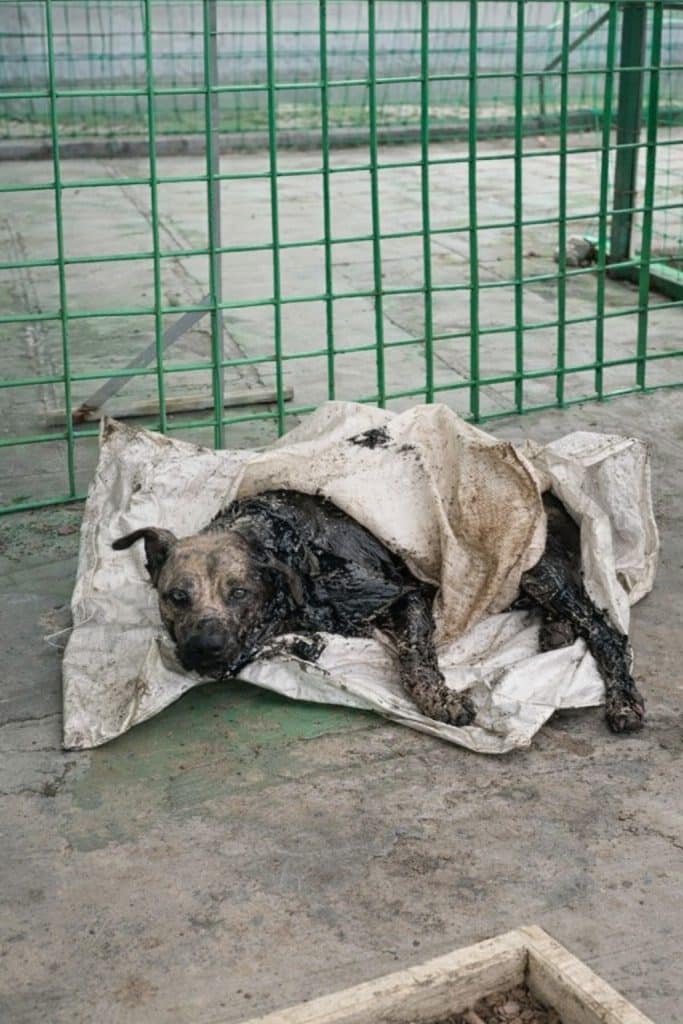
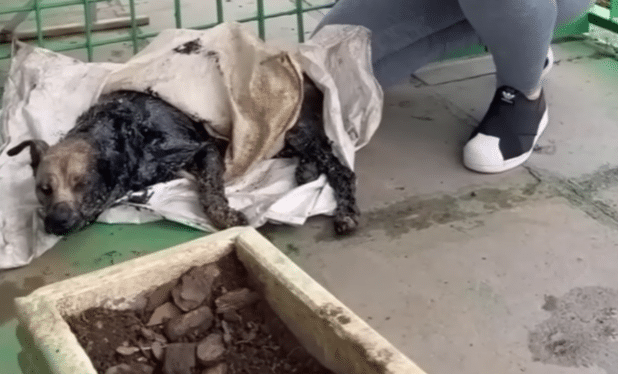
She had been tightly bound and covered in a thick layer of hardened asphalt, her body almost completely blackened by the sticky substance. Whoever had done this had hidden her inside the sack, leaving her among the trash as if she were something meant to be thrown away.
Yet she was still alive.
Barely breathing.
The asphalt clung to her fur and skin so tightly that even the smallest movement caused her visible distress. When rescuers arrived, they realized that removing the sack itself would be difficult — the material had stuck to her body where the asphalt had hardened.
For more than thirty minutes, the team worked carefully with scissors and cutters, slowly freeing her without causing further pain.
By the time she was finally lifted from the sack, her breathing had become weak and shallow.
But she was still fighting.
The rescuers quickly transported her to a veterinary care facility where treatment could begin
Video: Found Covered in Asphalt Inside a Trash Sack — Lucinda’s Fight for Lifeimmediately.
They would later call her Lucinda.
The first priority was removing the asphalt.
If left untreated, the substance could damage the skin severely and potentially allow toxins to enter the bloodstream. But the process could not be rushed.
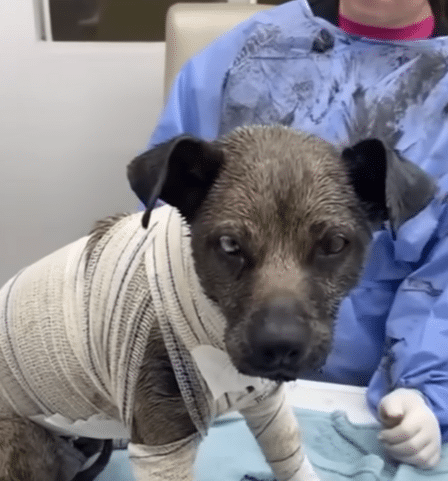
Using a combination of vegetable oil, mineral oil, warm water, and gentle cleansers, the rescue team began carefully dissolving the hardened layers. The work required patience — removing the asphalt piece by piece without pulling painfully at her skin.
Hours passed as the team took turns helping.
Eventually, the dark coating began to loosen.
But beneath it, Lucinda’s skin appeared red and badly irritated after being trapped under the substance.
Despite the exhausting process, the team remained focused on her comfort and safety.
Then an unexpected complication arose.
Lucinda developed a high fever.
Concerned for her stability, veterinarians paused the cleaning process and focused on bringing her temperature down. Soft bandages soaked in oil were applied every few hours to gently soften the remaining asphalt without causing additional stress.
Even during this difficult period, Lucinda showed quiet determination.
Though weak, she still accepted small amounts of food, a hopeful sign that her body had not given up.
Two days later, the fever subsided.
With her condition stabilized, the team resumed the cleaning process. By the end of the treatment, approximately ninety-nine percent of the asphalt had been successfully removed.
Yet another challenge remained.
Blood tests revealed elevated infection levels and a high white blood cell count, indicating that her body was still fighting serious inflammation. Careful monitoring continued as veterinarians worked to ensure her recovery stayed on track.
Slowly, Lucinda began to improve.
About two weeks later, the change was noticeable.
Her body relaxed more easily when people approached. Instead of shrinking away, she leaned gently into the comforting touch of the caregivers who had spent so many hours helping her.
Her eyes became clearer.
And those eyes held something remarkable.
Lucinda had heterochromia — two different colored eyes that gave her a uniquely beautiful expression. It was as if her appearance reflected the extraordinary story she had survived.
The rescue team attempted to find information about whoever had abandoned her, hoping to bring some form of accountability to the situation.
But there were no cameras near the garbage site.
No witnesses.
No clues.
The past remained a mystery.
Fortunately, Lucinda’s future would be very different.
The person who had helped rescue her chose to adopt her, ensuring she would never again face the cruelty that nearly ended her life.
Today, Lucinda lives in a home filled with warmth and companionship. She shares her space with other rescue dogs and spends her days exploring a sunny yard, resting comfortably, and receiving the affection she once lacked.
The sack in the garbage dump is only a distant memory now.
Lucinda’s story reminds us of something deeply important.
Even when cruelty tries to silence a life, compassion can still answer.
And sometimes, that compassion not only saves a life — it gives it a family.