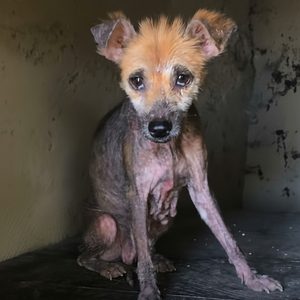
When Kong was finally discovered, it was clear that life had not been kind to him. His body was painfully thin, his movements slow and uncertain, and his eyes reflected a deep exhaustion that went far beyond physical hunger. He wasn’t aggressive. He didn’t cry out. He simply existed—quietly, patiently—like a soul that had learned not to expect much from the world anymore.
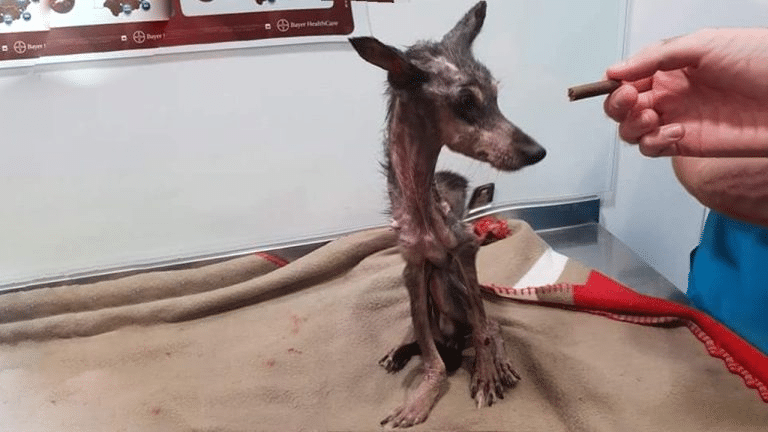
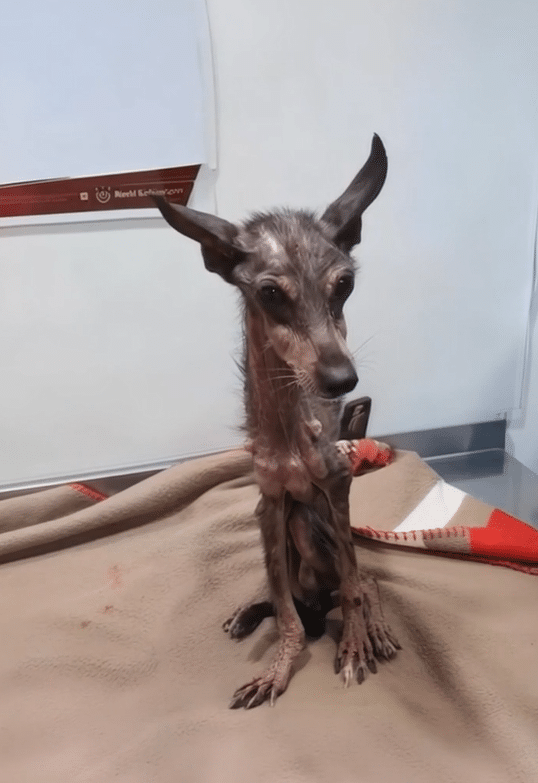
For a long time, Kong had lived in isolation. Confined to a small, unsanitary space with limited food and no room to move freely, his body gradually weakened. Without consistent nourishment or care, even simple tasks became impossible. At the time he was rescued, he could look at food with interest, but lacked the energy to eat it. Hunger had drained him to the point where his body no longer knew how to respond.
It was a heartbreaking sight, not because of dramatic movement or noise, but because of how still he was.
A Quiet Rescue That Changed Everything
The rescuers who found Kong knew immediately that time mattered. They moved carefully, speaking softly, aware that sudden movements could overwhelm a dog who had endured so much neglect. Kong didn’t resist. He allowed himself to be lifted, as if some part of him understood that help had finally arrived.
At the veterinary clinic, the atmosphere was calm but focused. The medical team worked gently and methodically, providing hydration and essential nutrients through intravenous support. Every step was taken with caution, knowing his body needed time to adjust after such prolonged deprivation.
Kong lay still during those first hours, conserving energy. He didn’t fight the treatment. Instead, he rested, surrounded by people who wanted nothing more than to give him a chance to recover.
Video When Hunger Silenced His Strength, Hope Gave Him a Second Chance
The First Signs of Hope
Recovery didn’t happen overnight. In fact, the early days were defined by patience and careful observation. Kong was unable to stand on his own at first, and eating required assistance. But slowly—almost imperceptibly—things began to change.
His eyes became more alert. He followed voices. He responded to gentle touch. When soft food was offered, he made an effort to chew, even when it clearly took everything he had. Those small moments meant everything to the people caring for him.
A slight tail movement. A longer moment of eye contact. These were not miracles, but they were progress—and progress was enough.
Learning to Stand Again
As days passed, Kong’s strength began to return. With support and encouragement, he tried to lift himself. His legs trembled. His balance was unsteady. But he tried again. And again.
One afternoon, he managed to stand for a few seconds. It wasn’t smooth or confident, but it was real. That moment marked a turning point. From there, each attempt became a little stronger, a little steadier.
When Kong finally took a few steps on his own, the room fell silent. No cheering. No applause. Just quiet smiles and misty eyes. Everyone understood how much effort it took for him to reach that point.
Even everyday actions—things most dogs never think twice about—became milestones. Each sign of normal function returning was a reminder that his body was healing, slowly but surely.
A Transformation You Could See and Feel
Weeks later, the change was undeniable.
Kong’s coat grew healthier. His posture improved. His eyes, once clouded with fatigue, now reflected curiosity and awareness. He began to seek out human connection, leaning into gentle hands, resting his head beside those who cared for him.
Play came next. At first, it was hesitant—an unsure nudge at a toy, a brief moment of interest. But soon, play became joyful. He discovered grass beneath his paws, open space, fresh air. He learned how it felt to move freely.
With each new experience, his confidence grew.
Healing Beyond the Physical
What made Kong’s journey especially powerful wasn’t just the physical recovery—it was the emotional one.
Despite everything he had endured, he chose trust. He didn’t withdraw from people or react with fear. Instead, he leaned in. He accepted affection. He offered it in return.
His personality began to emerge: gentle, playful, and occasionally clumsy in the most endearing way. He wasn’t defined by what he had survived. He was defined by who he became after.
To those who met him later, Kong was simply a happy dog. Energetic. Curious. Loving. Only those who knew his story understood the depth of his resilience.
A Life Reclaimed
Today, Kong enjoys the simple things—walks, meals, soft places to rest, and the comfort of companionship. He runs without hesitation. He eats with enthusiasm. He rests without fear.
Looking at him now, it’s hard to imagine the fragile dog he once was. But his story remains important, not because it’s tragic, but because it’s hopeful.
It reminds us that healing is possible—even after long periods of hardship. That patience matters. That kindness, given consistently, can restore not only bodies, but spirits.
Why Kong’s Story Matters
Kong’s journey is a reminder of the quiet heroes who work behind the scenes every day—rescuers, veterinarians, and volunteers who believe that every life deserves a chance.
It also reminds us that change doesn’t always come in dramatic moments. Sometimes, it comes in small steps. In waiting. In showing up again and again.
Kong didn’t just survive. He reclaimed his life.
And in doing so, he became something more than a rescue story. He became proof that compassion still has power, and that even when hope seems distant, it is never truly gone.
Every life matters. Kong’s story helps us remember why.