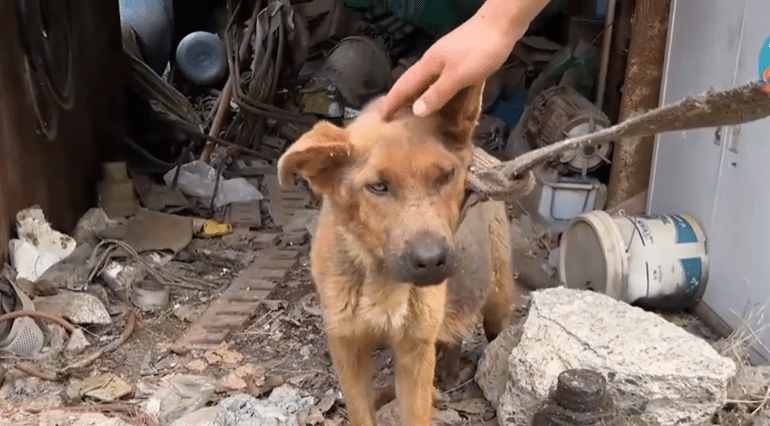
When they first found him, Fuwa was lying inside a crumbling, filthy building that felt long forgotten by the world. The floor around him was dirty, the air was heavy, and every part of the space seemed to reflect just how alone he had been. His small body looked weak and worn down, but what stood out most was his stomach—unnaturally swollen, stretched by a serious illness that had clearly been left untreated for far too long.
He did not bark or try to run.
He only looked at the rescuers with tired eyes, as if he had already spent too long waiting for help that never came. His former owner could no longer afford his medical care, and instead of finding treatment, had shut him away and left him there. By the time rescue arrived, Fuwa was no longer just a sick dog in need of medicine. He was a fragile life hanging quietly between suffering and hope.
The First Step Toward Something Better
The people who found him did not turn away.
They knelt beside him, spoke softly, and let him feel that he was no longer facing this alone. Even in pain, Fuwa seemed to respond to kindness. He allowed them to lift him, carry him out of the ruined space, and bring him somewhere safe. It was a small beginning, but for a dog who had been left behind, it meant everything.
At the clinic, the truth became clearer. Fuwa was trembling from fear and discomfort, his body exhausted from whatever he had endured before help reached him. The veterinary team worked carefully, running blood tests and examining him in detail. Each answer they found only revealed how much his body had been carrying in silence.
Video: After Being Left to Suffer With a Swollen Belly, Fuwa Finally Learned What Love Feels Like
What the Doctors Discovered
Fuwa’s swollen belly was not a mystery for long, but the diagnosis was heartbreaking.
He was suffering from a severe parasitic infection, including roundworms and liver flukes, which had done significant damage to his liver. Because his liver was no longer functioning properly, the protein levels in his blood had dropped too low. Without enough albumin to keep fluids where they belonged, liquid had begun leaking into his abdomen, causing the severe swelling that made every movement harder.
It was a dangerous condition, and recovery would not be quick.
The treatment plan was demanding: parasite control, medication to support his liver, close monitoring, and a carefully managed nutritional routine to help his body rebuild what illness had taken away. Fuwa had a long road ahead of him—but for the first time, there were people willing to walk that road beside him.
Healing Took More Than Medicine
As treatment began, Fuwa still carried the fear of everything he had been through. He shook often, unsure of the hands around him, unsure of the room, unsure of what would happen next. But unlike the world he had known before, this place brought comfort instead of neglect.
The veterinary team drained fluid from his abdomen to ease the pressure on his organs and help him breathe and rest more comfortably. His rescuers brought him soft bedding so he would not have to lie on a hard surface again. They offered him fresh food, including nourishing pieces of chicken, and stayed near him so he would not feel abandoned.
Slowly, the fear in his face began to soften.
There were moments when Fuwa looked at the people caring for him with something close to relief. And then one day, through all the exhaustion and uncertainty, he gave them what felt like the gentlest sign of trust—a soft, warm expression that looked almost like a smile.
The People Who Refused to Give Up
Fuwa’s recovery was not only emotionally demanding. It was financially difficult too.
His treatment required costly care, and even something as essential as albumin support placed pressure on the rescue team’s limited resources. But instead of stepping back, they worked harder. To help pay for his care, members of the rescue team took on physically exhausting labor in the fields, harvesting and cutting garlic under the hot sun, simply to keep Fuwa’s treatment going.
It was tiring work.
But every hour they spent laboring had a purpose.
Back at the clinic, Fuwa was fighting too. Day by day, the fluid in his abdomen began to lessen. His appetite improved. His movements became lighter. The dog who once seemed weighed down by illness started to show small signs of strength returning. Those signs may have looked ordinary to someone else, but to the people who had rescued him, they felt extraordinary.
A New Name for a New Life
As his condition improved, he was given a new name: Fuwa, a name meant to reflect luck, happiness, and the possibility of a brighter future.
And little by little, he began to grow into it.
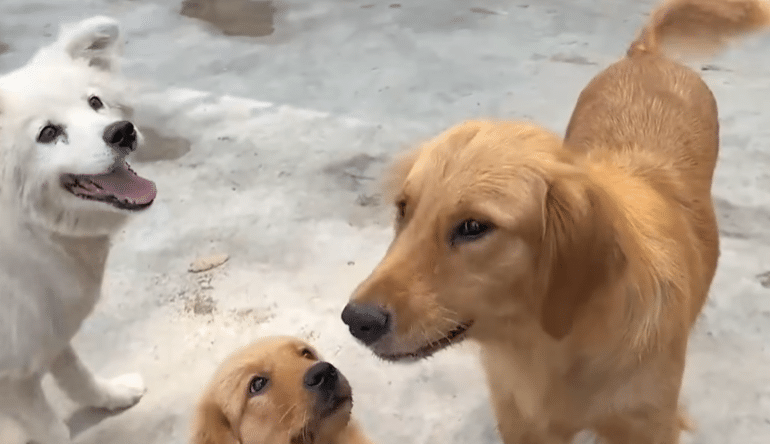
After thirty-eight days of patient treatment and constant care, Fuwa was finally well enough to leave the clinic. It was not just a discharge. It was the beginning of a life that once seemed impossible. He was taken to the rescue station, where a clean private space awaited him. There were soft places to rest, open areas to explore, and warm sunlight instead of darkness.
For a dog who had once been shut away in ruins, the change was almost beyond belief.
Soon he was walking outside, feeling the sun on his fur, moving with more ease, and discovering what safety could feel like. The heaviness that once defined him had begun to lift—not only from his body, but from his spirit.
What Fuwa’s Journey Leaves Behind
Today, Fuwa is no longer the dog who waited in pain inside an abandoned building. He is a living reminder of what persistence, compassion, and sacrifice can do when a life is at stake.
His story does not rely on shock.
It stays with us because of its gentleness.
Because people chose not only to rescue him, but to keep showing up for him when the cost became difficult. Because healing was built one day at a time—through medicine, through work, through patience, and through love. And because Fuwa, despite everything his body had endured, still found a way to trust again.
That is what makes his story unforgettable.
Not just that he survived.
But that he was given the chance to truly live.