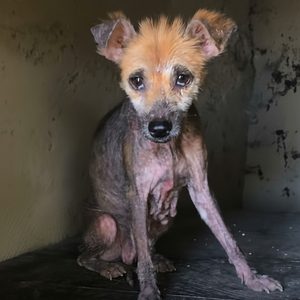
The forest was unusually still that morning, the kind of silence that wraps around you and makes every step feel louder than it should. Sunlight slipped through the tall canopy overhead, scattering across the ground in broken patterns as a young boy followed a trail he had run countless times before. It was familiar territory—comforting, even. Nothing about the day suggested it would become unforgettable.
Then he saw something that didn’t belong.
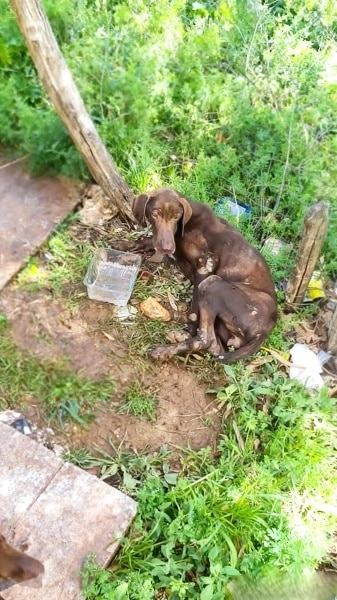
Just off the path, partially covered by dry leaves and low brush, lay a dog. At first, the boy thought it might be a fallen log or a shadow shaped by the light. But as he slowed and looked closer, his heart sank. It was an animal—motionless, thin, and curled inward as if trying to disappear into the forest floor.
The dog’s coat, once likely thick and healthy, hung loosely over a frail frame. His fur looked dull and neglected, offering little protection against the cool air. Even from a distance, it was clear this dog had been struggling for far too long. He trembled slightly, his chest rising and falling in shallow breaths that spoke of exhaustion more than rest.
What struck the boy most were the dog’s eyes.
They held no aggression, no fight—only confusion and quiet fatigue. It was the look of an animal who had waited and waited, unsure of what would come next. This wasn’t a dog who had wandered off by accident. Everything about him suggested he had been left behind.
The boy approached slowly, mindful not to startle him. He spoke softly, almost instinctively, letting calm words fill the space between them. The dog didn’t bark or attempt to move away. He simply watched, cautious but attentive, as if weighing whether this stranger posed another disappointment—or a chance.
Video Left Behind in the Woods, This Dog Found a Second Chance Through One Boy’s
It didn’t take long for the boy to understand the seriousness of the situation. The dog needed help, and time mattered.
He pulled out his phone and called a local animal rescue group, carefully explaining where he was and what he had found. He described the dog’s condition, emphasizing how weak he appeared. The response was immediate. Help was on the way.
While waiting, the boy made a choice that would change everything.
He stayed.
There was little he could do beyond that. He knew not to lift or move the dog, and he had no supplies beyond what he carried on his run. But he also knew something just as important: no one deserves to be alone when they’re already at their lowest point.
So he sat down on the forest floor beside the dog.
He positioned himself between the animal and the breeze, draping his jacket carefully to help conserve warmth. Every few moments, he spoke quietly—simple, reassuring words meant to fill the silence with something gentle. Slowly, the dog’s rigid posture softened. The shaking didn’t fully stop, but the tension in his body eased. For the first time in who knows how long, he wasn’t alone.
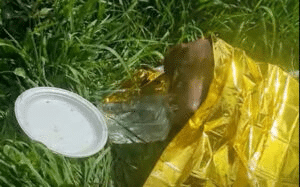
When the rescue team arrived, they moved with practiced care. They spoke calmly, assessed the dog’s condition, and prepared him for transport. The dog didn’t resist. If anything, he seemed to accept their presence, as though he understood that this moment marked a turning point.
Before they left, the boy looked at the dog one last time. There was no dramatic farewell. Just a quiet exchange of glances—an unspoken understanding that something important had happened on that trail.
Thanks to quick action and compassion, the dog was taken straight to a veterinary clinic. There, a full examination revealed the extent of what he had endured. He was severely malnourished and dehydrated, his body weakened by prolonged neglect. One of his back legs showed signs of injury that had clearly gone untreated, making even simple movement difficult.
Recovery would take time.
The veterinary team developed a careful treatment plan, introducing food slowly to protect his fragile system. Medications addressed underlying issues, and physical therapy was planned to help rebuild strength in his injured leg. Progress came in small steps—an extra bite of food one day, a steadier stance the next.
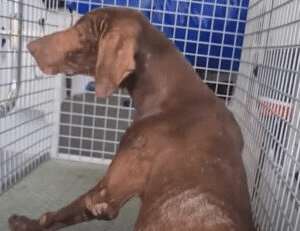
With each passing week, subtle changes began to appear. His eyes grew brighter. His tail started to move, cautiously at first, then with more confidence. The fear that once defined his behavior began to fade, replaced by curiosity and gentle trust.
What made the story even more meaningful was that the boy didn’t forget him.
Though life returned to its usual routines, the connection formed in the forest lingered. The boy visited the recovery center whenever he could. Each visit brought familiar comfort—the same calm voice, the same patient presence. And the dog remembered. His demeanor changed every time the boy arrived, his recognition clear and unmistakable.
Their bond became a reminder of how powerful simple kindness can be.
The boy wasn’t a trained rescuer. He didn’t have special equipment or experience. What he had was awareness—and the willingness to stop, to care, and to stay when it mattered most.
Today, the dog continues his journey toward full health, surrounded by people dedicated to giving him the life he was once denied. His future is no longer defined by abandonment, but by the promise of safety, stability, and love.
In a world where it’s easy to look away, this story stands as proof that compassion still changes lives. Sometimes, hope begins with one person on a quiet trail, choosing not to walk past—and deciding that staying is the right thing to do.