When Valya, a volunteer with a small animal welfare group, first arrived after receiving a brief message asking for help, she braced herself for a difficult scene. Even so, nothing fully prepared her for what she found. On the sidewalk lay a dog who barely resembled an animal at all—just a heavy, unmoving bundle of dirt, tangled fur, and quiet exhaustion. At first glance, it was impossible to tell where the dog ended and the debris of the street began.
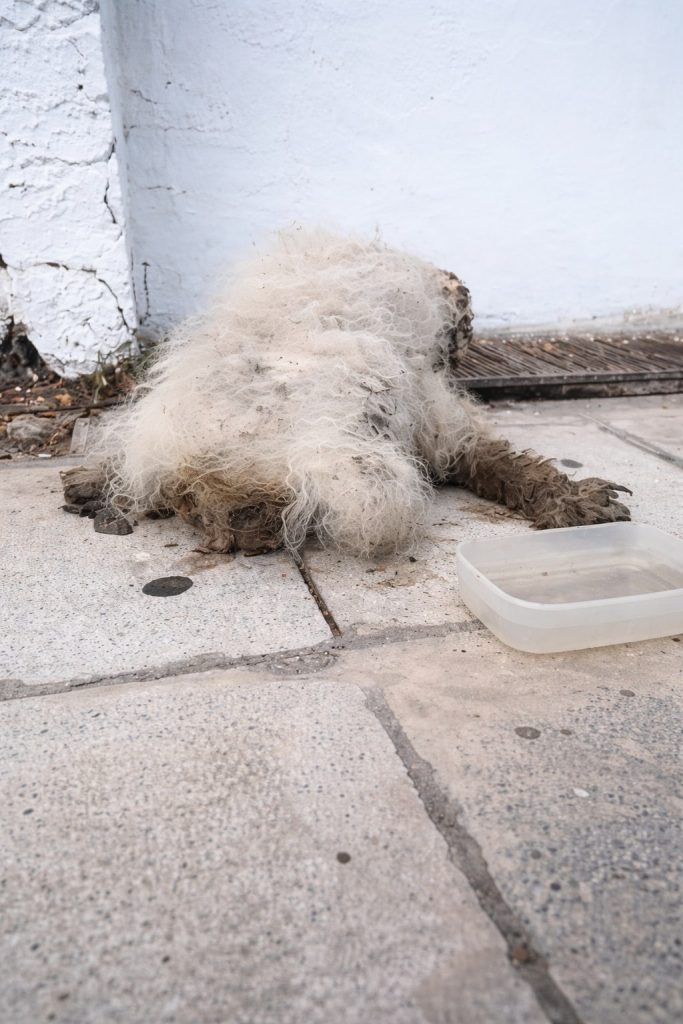
As Valya knelt beside him, she noticed something important. Despite his appearance, he was alive, alert in his own muted way, and still present in the moment. She gently placed a bowl of water near his mouth. Slowly, with great effort, he stirred. His tongue reached forward, not just for the water, but to softly lick her hand, as if acknowledging that someone had finally seen him.
That small gesture spoke volumes.
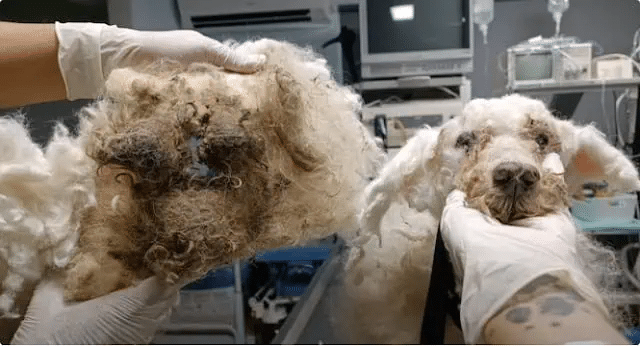
Later, Valya would learn fragments of the dog’s past. He had once belonged to an elderly woman who had passed away. When her apartment was cleared out, the dog was left behind, unintentionally forgotten in the rush of closing a chapter. No one could say exactly how long he survived alone—weeks, months, or perhaps even longer. What was clear was that time had not been kind. With no regular care, his fur had grown unchecked, trapping layers of dirt and moisture until it hardened into something resembling armor.
Valya named him Julian, a name that felt gentle and dignified, fitting for a dog who had endured so much without losing his calm spirit. She carried him to her car and drove straight to the veterinarian, knowing every moment mattered.
At the clinic, the true extent of Julian’s condition began to unfold. Removing his matted coat was not a simple grooming task. It was a careful, time-consuming process that required patience and compassion. Over the course of four long hours, veterinarians and volunteers slowly shaved away the dense layers that had weighed him down for so long.
Video Abandoned Dog Rescued After Living Under Layers of Dirt and Fur
What astonished everyone was Julian’s demeanor. He didn’t panic. He didn’t resist. He stood quietly, as if he understood that this discomfort was part of a necessary change. No anesthesia was needed. He simply trusted the hands working to free him.
When the final layer fell away, the dog beneath was revealed. Julian was a poodle, smaller than expected, fragile in body but steady in presence. Without the heavy coat, other health concerns became visible. He had a heart condition that would require ongoing care, along with partial hearing and vision loss. These challenges explained his slow movements and cautious reactions to the world around him.
Still, none of these diagnoses defined who Julian was.
In the days that followed, Valya spent time getting to know him beyond the medical charts. Julian wasn’t a dog who immediately fit into the image many people imagine when they think of adoption. He wasn’t playful in the traditional sense. He didn’t rush to greet strangers or respond quickly to commands. His personality was strong, independent, and shaped by years of self-reliance.
And yet, there was something deeply compelling about him.
Julian enjoyed quiet companionship. He liked sitting nearby, observing rather than participating. When he felt safe, he leaned into gentle touch, not demanding affection but clearly appreciating it. His calm presence filled a room without noise or fuss.
Valya often reflected on how society tends to value perfection, even when it comes to rescue animals. Puppies are chosen quickly. Dogs with no visible health issues find homes faster. Those who are older, slower, or imperfect are frequently overlooked. Julian fell into that category—not because he lacked worth, but because his needs required understanding and patience.
Now under the care of a rescue organization dedicated to helping stray animals, Julian continues his recovery. He receives regular medical attention and lives in a safe environment where his limitations are respected rather than pushed. While he is technically available for adoption, Valya is honest about the reality: finding the right home for a dog like Julian is not easy.
Potential adopters must be willing to look beyond appearances and expectations. They must see value in companionship that is quiet rather than energetic, in loyalty that is expressed through presence instead of performance.
Valya often says that not every rescue story ends with a dramatic transformation or a picture-perfect conclusion. Some journeys are quieter, slower, and more complex. Julian’s story is one of those. It isn’t about becoming something else. It’s about being accepted exactly as he is.
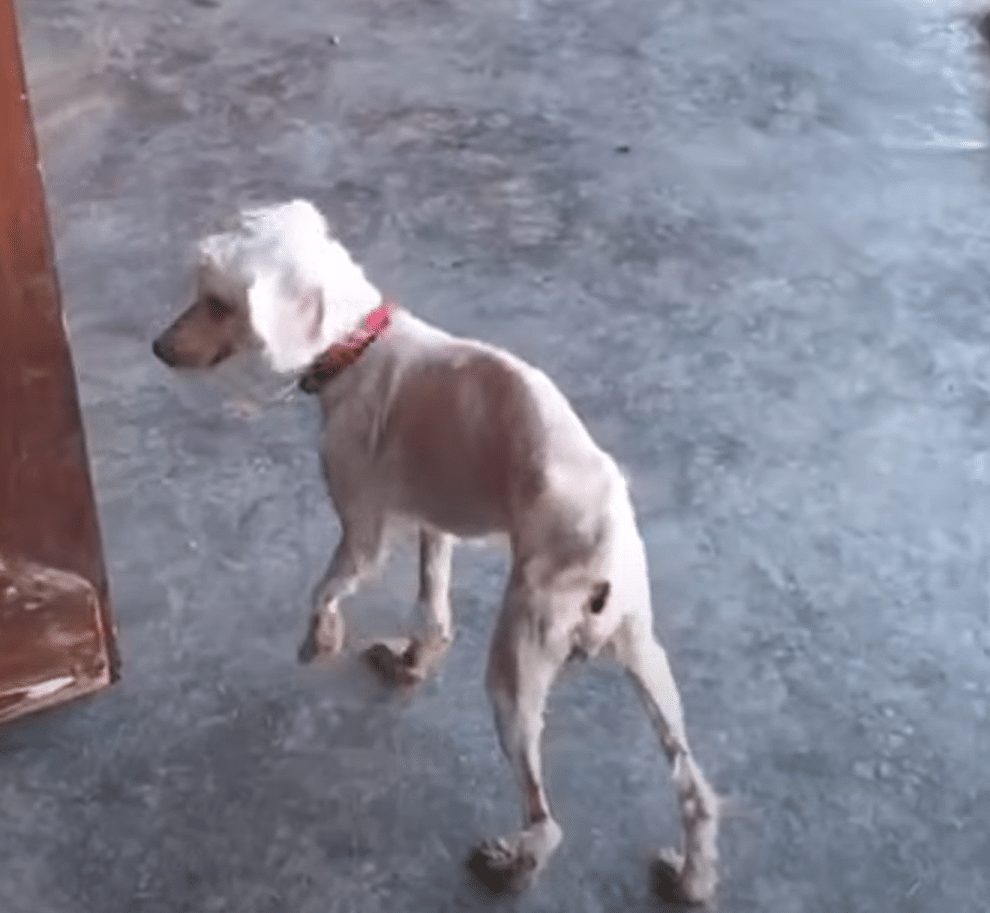
Julian may never be the dog who runs freely through parks or learns an endless list of tricks. But he is a living reminder that resilience doesn’t always look bold. Sometimes it looks like survival. Sometimes it looks like trust offered after loss. Sometimes it looks like a gentle lick on the hand of a stranger who chose to stop and care.
In a world that often celebrates only the easiest success stories, Julian stands as proof that every life—no matter how worn, weathered, or imperfect—deserves dignity, patience, and love.