As Hurricane Milton advanced toward Florida’s coastline, a familiar sense of urgency swept across the state. Emergency alerts sounded through phones and televisions. Officials repeated evacuation orders with growing intensity. Families made difficult decisions in a matter of hours—packing essentials, securing homes, and joining the steady stream of traffic moving inland. The message was unmistakable: this storm posed a serious threat, and waiting was not an option.
In the midst of that chaos, a brief video surfaced online. It lasted only seconds, yet it left an imprint that words alone struggled to capture.
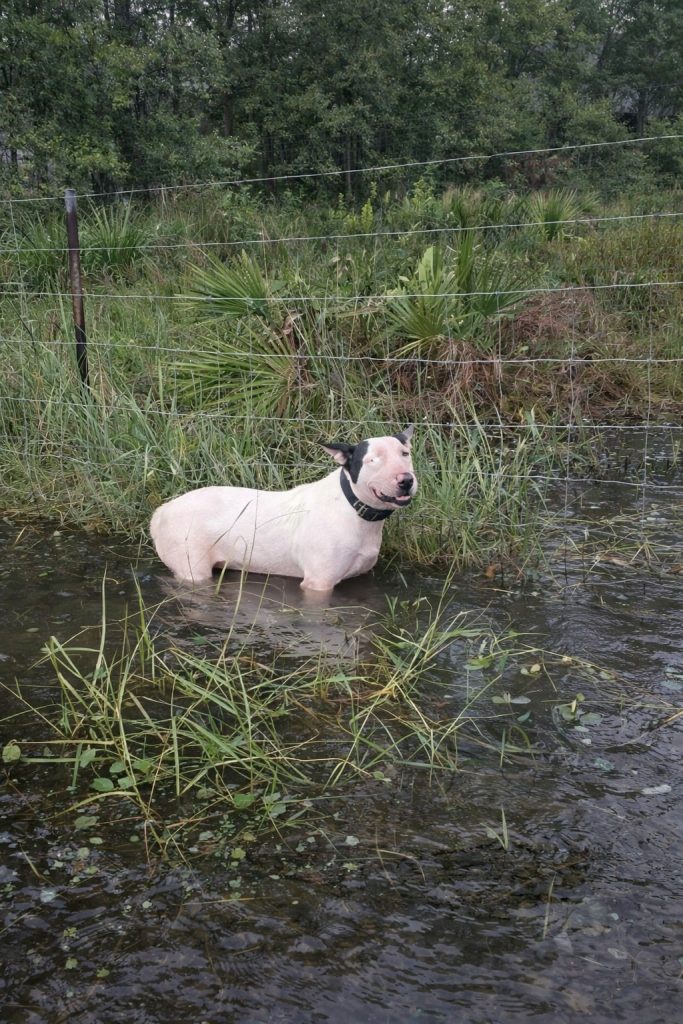
Recorded along a highway already overtaken by floodwater, the footage showed a lone dog tied to a fence post beside the road. Water pooled and surged around his legs. Wind whipped across the open stretch of pavement. Vehicles rushed past, drivers focused on escaping the storm’s path. The dog, soaked and motionless, had nowhere to go.
The scene did not rely on dramatic imagery or heightened sound. Its power came from its simplicity. A storm. Rising water. And an animal restrained in place, dependent on a choice that had already been made.
Within hours, the video spread rapidly across social media. Viewers from across the country reacted with disbelief and heartbreak. The outrage was immediate, not because of what was shown in graphic detail, but because of what was implied. The danger was obvious. The vulnerability was undeniable.
The dog did not panic or struggle against the rope. He stood still, bracing himself, as if trying to make sense of the situation unfolding around him. There was fear in his posture, but also a quiet endurance. To many viewers, it looked like waiting—waiting for someone who had not returned.
That stillness struck a nerve.
As Hurricane Milton intensified, officials continued to warn that conditions would soon become life-threatening. Flooding, storm surge, and strong winds created serious risks for anyone who remained in affected areas. Evacuation orders were issued with clarity and urgency. Against that backdrop, the image of a dog left behind felt impossible to reconcile.
Video Left Behind in the Rising Waters: The Image From Hurricane Milton That Sparked National Outrage
Public reaction poured in from every direction. Comment sections filled with calls for accountability. People tagged local authorities, animal control services, rescue organizations, and news outlets, hoping someone could reach the dog in time. The video was shared again and again, not as spectacle, but as a plea. Viewers wanted action, not attention.
What fueled the intensity of the response was how avoidable the situation seemed.
This was not a sudden accident or an unforeseeable outcome. Someone had time to secure the rope. Time to fasten the knot. Time to leave. Those same moments could have been used to bring the dog along, to ask for help, or to make a different choice. That contrast—the ease of prevention versus the weight of consequence—sparked widespread anger.
During natural disasters, animals depend entirely on human decisions. They do not understand warnings or evacuation routes. They trust the people responsible for them to act with care. When that trust is broken, animals have no ability to protect themselves.
The image from Hurricane Milton reopened a conversation that emerges with nearly every major storm: what responsibility do people have toward their pets when disaster strikes?
Emergency planners and animal welfare advocates have long emphasized the importance of including pets in evacuation plans. Many shelters now accommodate animals, recognizing that people are more likely to leave dangerous areas when they can bring their companions with them. Despite these efforts, stories of animals left behind continue to surface, and each one highlights a painful gap between awareness and action.
The reaction to this video was not driven by sensationalism. It stemmed from a shared understanding that abandoning a defenseless animal in the face of a deadly storm crosses a moral line. It challenged viewers to consider responsibility beyond personal survival and to confront the choices made under pressure.
Alongside the anger, something else took shape: collective compassion.
Strangers offered help in every form imaginable. Some volunteered to foster or adopt. Others pledged donations or assistance to rescue groups. Ordinary people used their voices to demand intervention. The image became more than a moment of outrage—it became a catalyst for empathy and action.
Natural disasters often reveal the extremes of human behavior. They bring out courage, generosity, and solidarity. They also expose moments where fear overrides compassion. In this case, one dog standing in rising water forced a national reckoning. It asked a difficult but necessary question: who do we protect when everything feels at risk?
Animals may not speak or advocate for themselves, but their vulnerability places a profound responsibility on those who care for them. How a society treats its most powerless members—especially during moments of crisis—reflects its values in ways that words cannot.
For many who saw the video, the hope was simple and sincere: that the dog would be rescued, and that his suffering would not be meaningless. That his story would lead to accountability, awareness, and change. Storms eventually move on, but the decisions made during them leave lasting impressions.
This image will not fade easily from memory. It endures because it represents more than a single moment or a single animal. It stands as a reminder of how quickly compassion can be tested—and how essential it remains, even under threat.
Yet it also carries a quieter message of hope.
It shows the power of collective response rooted in empathy. It proves that people care deeply about lives that cannot advocate for themselves. And it reminds us that compassion is not optional, even when fear is loud.
As storms like Hurricane Milton grow stronger and more frequent, preparedness must extend beyond personal safety. It must include those who depend on us completely. Pets are not possessions. They are family. And in moments of danger, family does not get left behind.
Sometimes, all it takes is one image to remind us of who we are—and who we should strive to be.