A leash lay against the pavement, a small body beside it, and a story that almost went unnoticed.
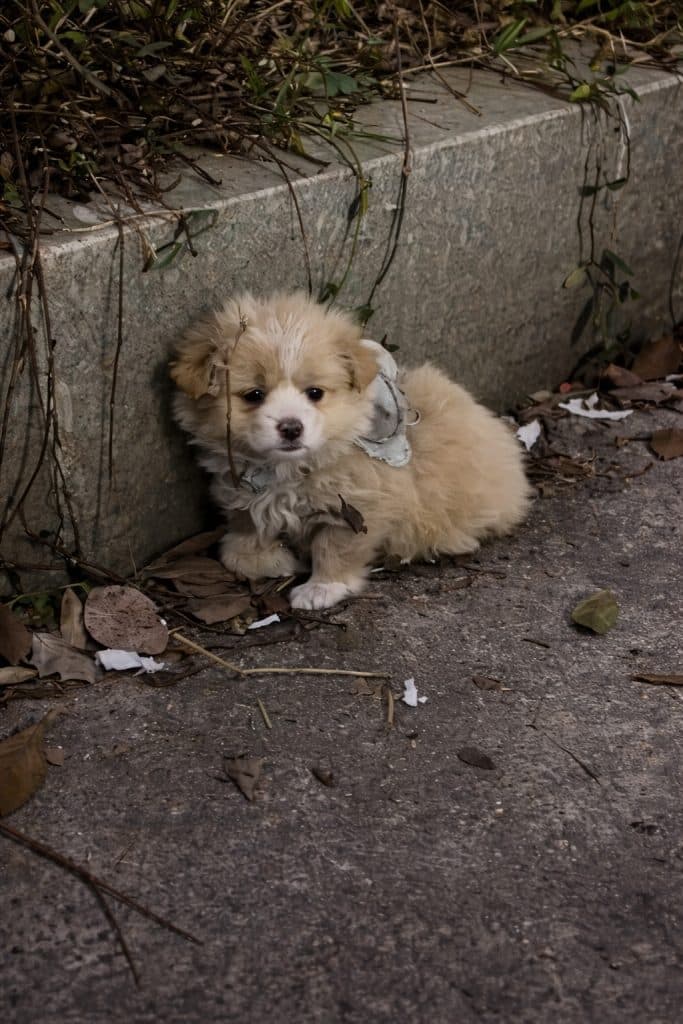
On a busy stretch of road, where traffic flowed and people hurried past, a tiny puppy rested near the curb. His leash was still clipped to his collar, stretching a short distance across the ground. To anyone passing by, the scene didn’t immediately raise alarms. It looked like a brief pause, the kind you see every day. Maybe his owner was nearby. Maybe he had wandered off and would be reclaimed at any moment.
But Latte wasn’t waiting for anyone.
He was frozen in place.
For close to two full days, the puppy remained in the same spot. His body stayed low, his head barely lifted, his eyes dull with exhaustion and fear. Cars sped past just feet away, their movement sending gusts of air across his small frame. People came and went, conversations drifted by, footsteps echoed and disappeared. Through it all, Latte didn’t bark. He didn’t cry. He didn’t tug at the leash or follow anyone who slowed down.
He didn’t move.
That stillness wasn’t calm or patience. It was fear settling deep into a fragile body.
Young puppies don’t know how to survive on their own. They don’t understand roads, danger, or how to seek help. When they’re overwhelmed, many don’t react the way people expect. Instead of crying out, they shut down. They become quiet, conserving what little energy they have, hoping that if they stay still long enough, the danger will pass.
That’s what Latte did.
Someone noticed him lying there, leash attached, eyes vacant. Something felt off, but uncertainty lingered. It took another couple of days before a local resident finally shared his photo in a community chat, asking if anyone recognized the puppy or knew where he belonged.
That message reached someone who couldn’t ignore it.
A young woman read the post and felt a pull she couldn’t explain away. She decided to go see the puppy herself.
Video A Leash, a Roadside, and a Puppy Who Didn’t Move: How Latte’s Life Changed Because One Person Stopped
The moment she approached, the truth revealed itself. Latte panicked. With a burst of frightened energy, he scrambled beneath a parked car, his small body trembling so hard it rattled against the gravel. His tail tucked tight. His legs shook uncontrollably. This wasn’t a lost pet waiting patiently.
This was a puppy overwhelmed by terror.
Silence in animals is often misunderstood. People assume quiet means calm or obedience. In reality, extreme fear can make animals freeze completely. Latte wasn’t being good. He was trying to survive.
The woman didn’t rush him. She didn’t grab or shout or force him out.
She lowered herself to the ground, spoke softly, and waited.
Minutes passed. Latte stayed hidden, watching her closely, tracking every sound and movement. Slowly, inch by inch, he crawled out from under the car. His legs wobbled as he stood. When she reached for him, he didn’t resist. He allowed himself to be lifted, as if fear had finally exhausted him.
For the first time in days, Latte felt warmth instead of pavement.
That moment divided his life into two parts: before he was seen, and after.
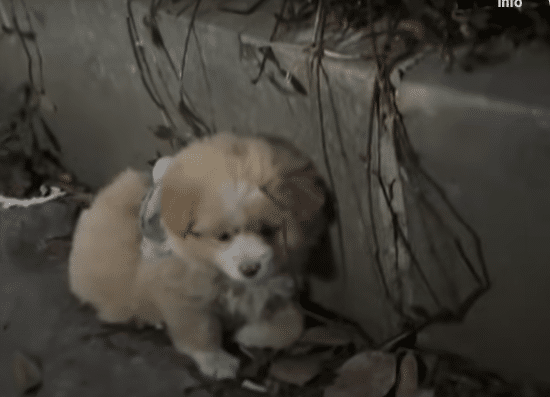
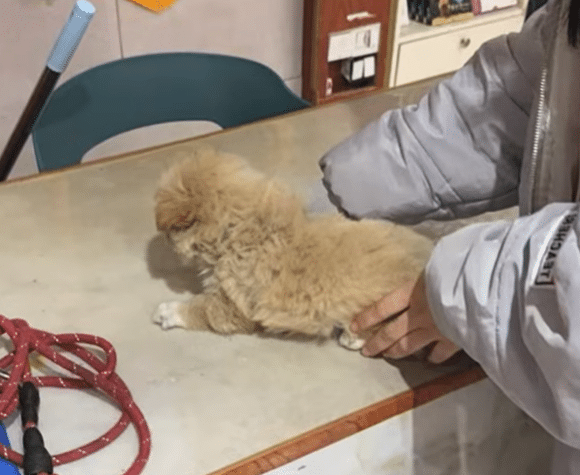
He was taken straight to a veterinary clinic, where the seriousness of his condition became clear. Latte was barely over a month old, around forty days. Tests revealed he had contracted canine coronavirus, a contagious intestinal illness that can be especially dangerous for young puppies. At that age, dehydration and weakness can escalate quickly.
Time mattered.
Despite everything, Latte showed signs of resilience. During his examination, he had an accident on the vet’s table. It was messy and unexpected, but it also meant his body was still working. He hadn’t given up.
Neither had the woman who found him.
Once released, Latte went home with her, and recovery became a constant, careful effort. He was treated like a newborn. His food was softened with goat milk to protect his sensitive stomach. He was kept warm when temperatures dropped. Meals were small and frequent. Water was offered constantly. The environment stayed quiet and calm.
At first, Latte barely ate.
Then he nibbled.
Then he finished a meal.
He began standing more steadily. His eyes grew brighter. His tail lifted slightly. One afternoon, he surprised everyone by wagging it, just a little, but enough to signal change.
As his body healed, something deeper happened.
His personality emerged.
The puppy who once lay motionless by the roadside became curious and expressive. He barked at unfamiliar sounds. He followed his rescuer from room to room. He learned simple commands and explored the yard as if it were a brand-new world. At night, he slept deeply, curled up warm and secure, no longer listening for danger.
His healing wasn’t only physical.
It was emotional.
Safety gave Latte permission to be a puppy.
Months later, it was hard to believe he was the same dog. He gained weight, received proper vaccinations, and moved with confidence. His coat became soft and healthy. His eyes, once guarded and dull, now sparkled with trust.
Most importantly, Latte had what he never had on that roadside.
A home.
A family.
A childhood that almost slipped away unnoticed.
Latte’s story matters because it highlights something easy to miss. Not all animals in distress cry for help. Some grow silent. Some freeze. Some lie still with a leash attached, hoping someone will recognize that “waiting” is actually fear.
His life didn’t change because of luck.
It changed because one person stopped, looked closer, and chose compassion over assumption.
Sometimes, that single choice is enough to save a life.