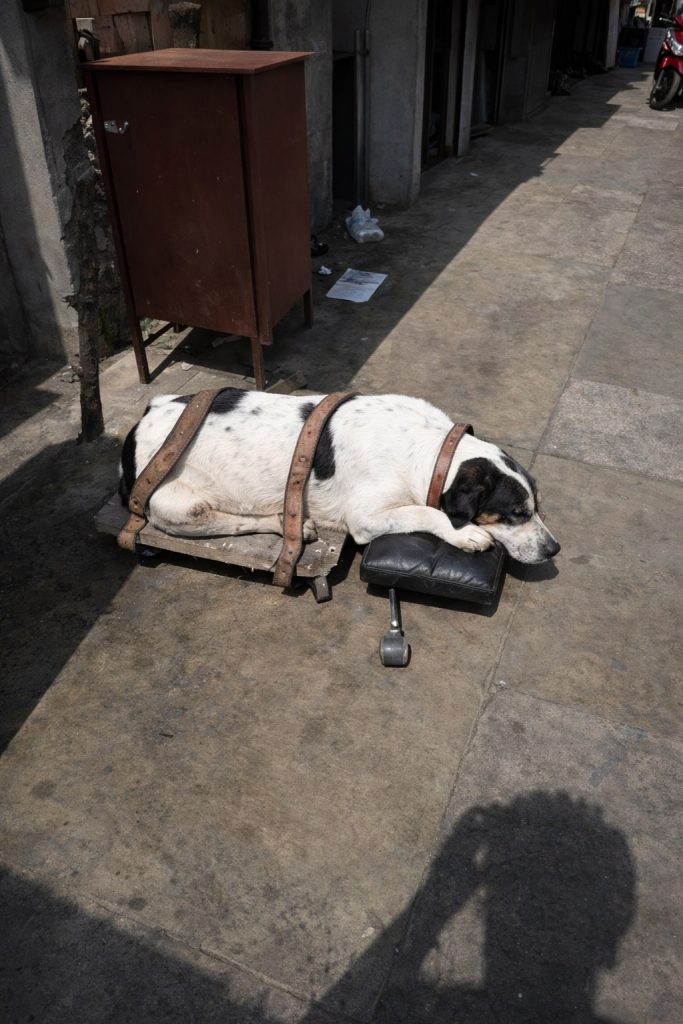
At one of the busiest train stations in Lima, Peru, where announcements echoed and people rushed past without slowing down, a small dog sat motionless beside a piece of wheeled equipment. He was tied tightly, as if deliberately placed where he would blend into the noise and chaos. Travelers came and went all day, eyes fixed ahead, unaware that a life was quietly unraveling just feet away.
A body too tired to ask for help
The dog’s posture told a painful story. His head drooped forward, held up only by sheer effort. Thick straps pressed into his body, leaving him unable to shift or lie down. He did not bark or pull against his restraints. He simply endured, conserving what little strength he had left. Later, he would be called Cabezón, a gentle nickname inspired by the way exhaustion caused his head to fall forward — but in those moments, he was just another forgotten animal.
Video: Tied at a Train Station and Left Behind — How One Dog Was Finally Seen
The smallest hands noticed first
Hours passed before anyone truly stopped. It wasn’t hurried adults or station staff who noticed him, but a few children whose curiosity and compassion cut through the routine of the day. They saw the way he struggled to breathe, the fear in his eyes, and the stiffness in his body. They brought him food and water, staying close as if their presence alone might ease his suffering. With careful effort, they managed to free him from what held him there — only to realize how severe his condition truly was.
Word of the dog soon reached Sara Moran, founder of Milagros Perrunos, a small rescue in Peru known for helping dogs with severe disabilities. When she heard what had happened, she didn’t hesitate. From the injuries described, it was clear Cabezón had likely been abandoned after damaging his hind legs — left behind when caring for him became too difficult. Sara knew this kind of story all too well.
When the full truth came to light
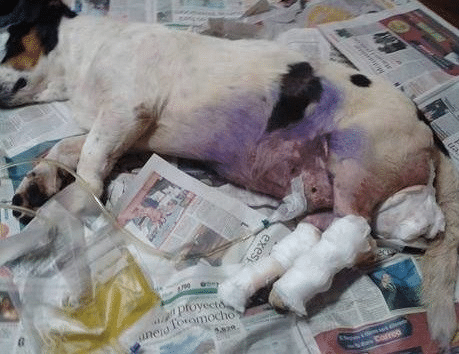
At the shelter, veterinarians carefully examined Cabezón. The findings were heartbreaking. He had suffered serious spinal trauma, kidney failure, untreated wounds, and internal damage caused by being restrained in one position for too long. He had endured pain, immobility, and neglect without relief. The prognosis was grim: even if he survived, he would never walk again.
A place where “hopeless” doesn’t exist
For many dogs, this diagnosis would have marked the end. But Milagros Perrunos was built for cases exactly like his. Cabezón was given a soft bed, clean bandages, and round-the-clock care. Volunteers adjusted his position, monitored his comfort, and spoke to him gently. Despite his weakness, he responded — lifting his eyes when someone approached, relaxing under a kind touch. Recovery was slow, uneven, and uncertain, but dignity replaced despair.
No longer invisible
Cabezón’s future remains fragile. His medical needs are complex, and his mobility may never return. But what he has now is something he was once denied entirely: safety, patience, and people who refuse to look away. In a world that passed him by without stopping, he is finally seen — not as a burden, not as a problem, but as a life that matters.